Ace (1) of Wands
Appearance
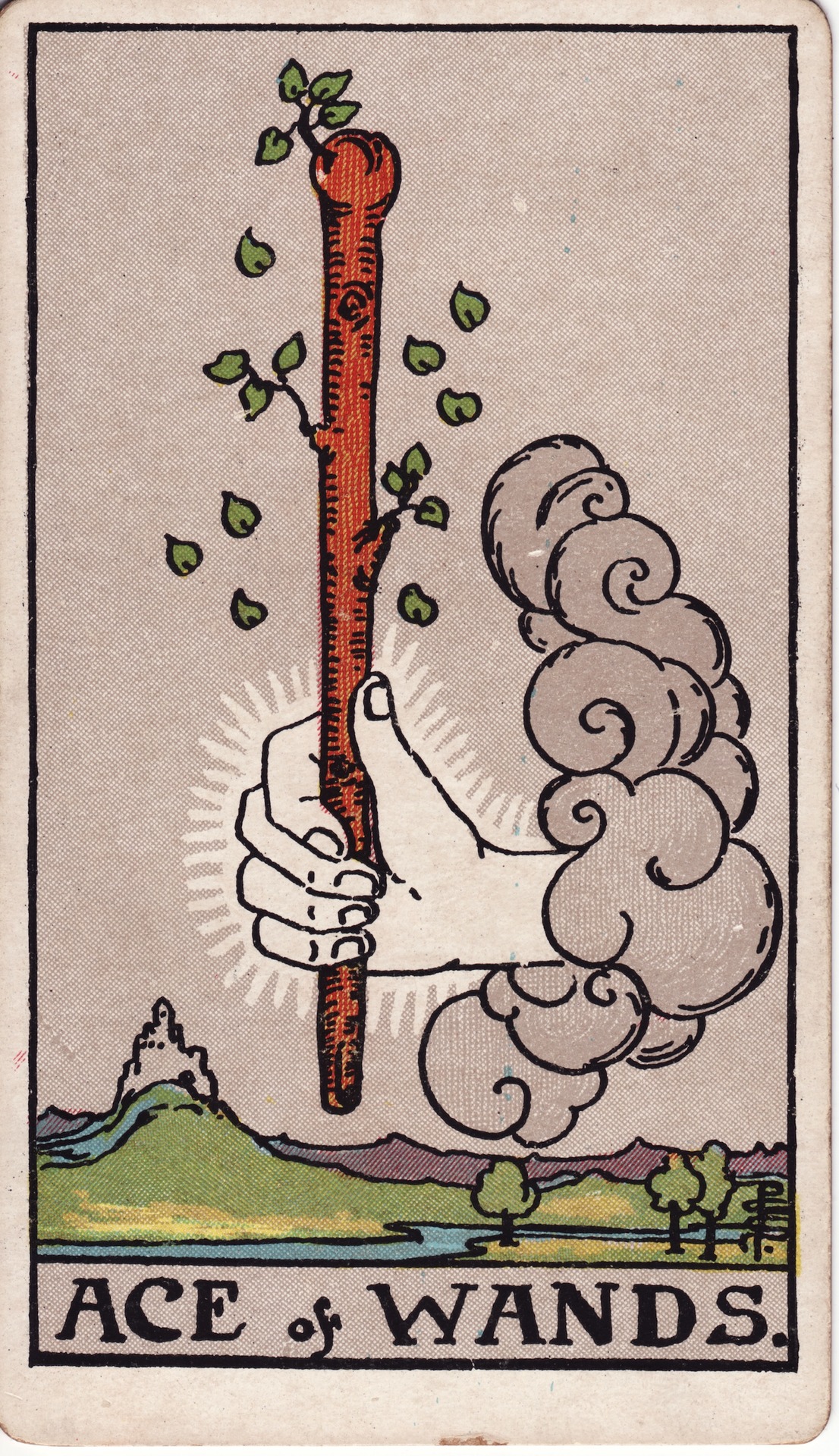
A hand emerges from a gray cloud on the right side of the card, ringed by a faint white glow, and grips a thick wooden wand held upright. The wand is alive: small branches sprout from it, and eight loose green leaves drift down through the air around it. Below lies a peaceful landscape of green fields, a winding river, and a few trees, and on a hill to the left stands a castle on a rocky crag. Distant mountains line the horizon.
Each ace is the root of its suit, offered from the cloud as a gift. Wands belong to fire: energy, will, ambition, creativity, and the urge to act. Waite described the card as a hand from a cloud grasping a stout wand or club, and noted elsewhere that the wands of this suit are always in leaf, because it is a suit of life and animation.1 The fertile valley repeats what the leaves say: whatever is planted here can take root. The castle on its crag reads as where the new venture could eventually lead, and the mountains past it as the rough ground in between, real obstacles but ones that effort can get you across.2
Upright
The Ace of Wands is a spark: the first surge of energy behind something new. Waite's meanings center on creation, invention, and enterprise, on principle, beginning, and source, and on the starting point of enterprises.1 It often appears just before an idea becomes a plan, when the enthusiasm is real but nothing has yet been built. Where the other aces offer potential in feeling, thought, or material things, this one offers it in drive and spirit: ideas come easily, and with them a pull toward a path you have not tried.2 Asked as a yes or no question, the card is a firm yes.2
At work, it favors starting the project, pitching the idea, launching the business, or taking the role that asks you to create rather than maintain. It can also mark a burst of inspiration after a dry stretch. If you are someone who likes to research every angle first, the card argues for trusting your instinct and beginning now; a few basics are enough to get moving, and the more elaborate parts can come once the thing exists. Treat the first version as a trial, keep what works, change what does not, and let your own energy tell you which is which.2 With money, Waite records an older reading of fortune and inheritance, and more generally the card supports ventures begun on your own initiative.1 Still, an ace is a seed and not a harvest. The opening is real, but only steady effort turns a promising first week into something that lasts.2
In love, the Ace brings attraction and heat: a new romance that starts with strong chemistry, or a revival of desire in an existing relationship. Waite's list includes birth, family, and origin, and the card has long been read as a sign of conception or a new arrival in the family.1
On a personal level, it is the moment when you know what you want to do and have the energy to begin. It can point to growth through learning, such as signing up to study a craft or practice that has been tugging at you, on the understanding that it will open further doors.2 The advice is simple: take hold of the wand while it is being offered.
Reversed
Reversed, the spark fails to catch. An idea stalls before it starts, enthusiasm fades as soon as the real work begins, or a launch is delayed by circumstances or by your own hesitation. At work, this can look like creative block, a project that never gets off the ground, or energy scattered across so many beginnings that none of them is finished.
Sometimes the fire is present but has no shape yet. You can feel something forming without knowing what it will become, and you may hold it back, waiting on some outside event or keeping it to yourself until you trust it more. That is an earlier stage rather than a failure; the work is to find a channel for the energy before it leaks away.2 A related reading is a loss of direction: restlessness with the current path, with no clear picture of a better one, which drains motivation. The cure there is less about effort and more about asking what you actually care about, since a goal that does not move you will not hold you.2
The opposite form is impulsiveness: rushing into something on a surge of excitement without the stamina or the plan to carry it through. In love, it can mean attraction that burns out quickly, mismatched desire, or a relationship that never moves past the first spark. And sometimes the reversal is simply about timing. Delays outside your control hold things up just as momentum was building, and the counsel is to wait for a better opening rather than force it.2
Waite's reversed meanings are much darker than most modern readings: fall, decadence, ruin, and, in his words, a certain clouded joy.1 His additional notes also record the reversed Ace as a sign of birth.1 Read gently, the card asks what is blocking your drive. Rest, a smaller first step, or a clearer reason for beginning may be enough to bring the fire back.
Notes
- A. E. Waite, The Pictorial Key to the Tarot (1911), Ace of Wands, https://sacred-texts.com/tarot/pkt/index.htm
- Biddy Tarot, "Ace of Wands Tarot Card Meanings", https://biddytarot.com/tarot-card-meanings/minor-arcana/suit-of-wands/ace-of-wands/