Eight (8) of Pentacles
Appearance
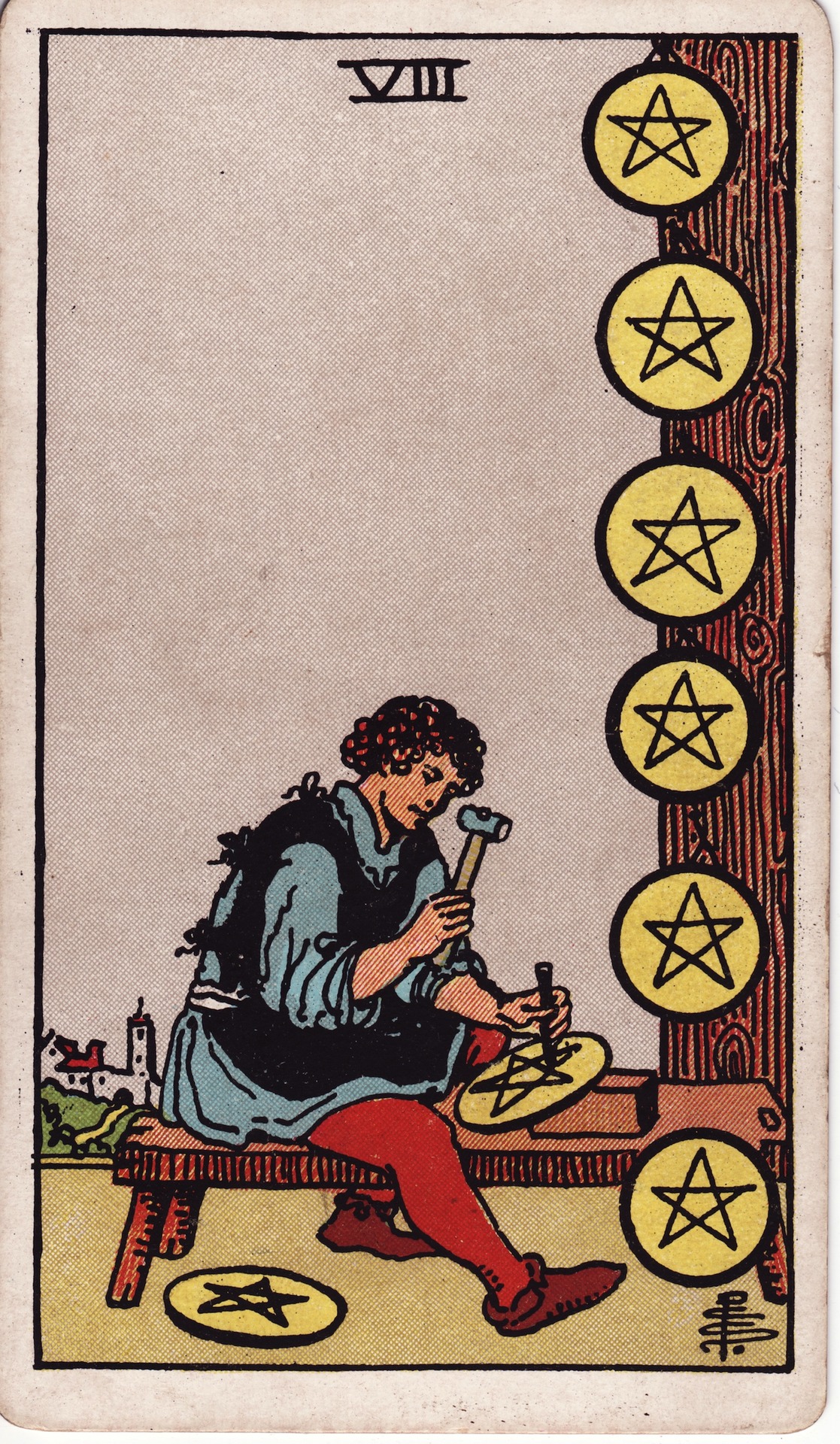
A young craftsman with curly hair sits on a wooden bench, bent over his work. He wears a blue smock with a dark apron and red hose, and with a hammer and chisel he is carving the star into a pentacle propped on the bench in front of him. Six finished pentacles hang one above another on a tall wooden post to his right, displayed like trophies, and another lies on the ground beside the bench. In the distance on the left, a small white town stands on a green hill, well away from the workshop.
Waite described him simply as "an artist in stone at his work."1 Eight is often read as a number of movement and mastery pursued through repetition. The distance between bench and town can be read as a choice: he has stepped back from the noise and obligations of ordinary life so that nothing competes with the job in his hands.2 The card belongs with the Three of Pentacles, where Waite says the same apprentice has earned his reward.1
Upright
The Eight of Pentacles is the card of diligent work and growing skill. The figure is absorbed in a single task, repeating it carefully, and each finished piece is a little better than the last. Waite's meanings are work, employment, commission, and craftsmanship, "skill in craft and business, perhaps in the preparatory stage."1 This is the apprentice years, the practice that makes mastery possible.
At work, it often points to training, study, an apprenticeship, or a new role where you are learning the trade. It often follows some shift in job, schooling or finances, with the card describing the stubborn concentration you now bring to the new demands.2 It can also describe being commissioned for a job, earning a reputation for reliability, or settling into steady, focused effort on a project that rewards attention to detail. The apprenticeship need not start from zero: the card fits just as well someone already competent who has decided to go deeper, the decent amateur who now wants real expertise and accepts that it will take time.2 With money, it favors earning through effort rather than luck: building income one job at a time, improving your skills to raise your value, and avoiding shortcuts.
In love, the card suggests a relationship that is being worked on with care, two people willing to put in the effort that lasting partnership needs. For someone single, it can mean a period of focus on self-improvement before turning outward. More generally it can show someone tidying up the many small corners of a life they are not yet satisfied with, one adjustment at a time, and it counts that commitment as a good sign.2 On the inner level, the eight asks you to value the process itself: the quiet satisfaction of doing a thing well, and the patience to keep at it.
As advice, the card says to keep going. Results may be slower to show than you would like, but the steady work is moving things in the right direction, and the effort put into your own growth will repay itself.2 If you are not working toward anything just now, it asks what you might study or make that would improve your lot.2
Reversed
Reversed, the effort goes astray. Work becomes mindless repetition with no growth behind it, or skill is never developed because the patience to practice is missing. It can describe careless work rushed out the door, or the opposite, perfectionism that stops anything from being finished. The perfectionist fixes on each small detail until the purpose of the whole task drops out of view, and grows so attached to one right way of doing things that any change of plan becomes a crisis; the cure is to accept that flawless work does not exist.2 At work, the reversed eight can point to a dead-end job, a lack of training, or ambition without the dedication to back it up. Sometimes long hours simply do not pay off, and the honest question is whether this is the right craft for you at all, or whether a crowd of small tasks is keeping you from the larger goal.2
Waite's reversed meanings are voided ambition, vanity, cupidity, exaction, and usury.1 He adds that the card may signify skill turned toward "cunning and intrigue": cleverness used to deceive rather than to build.1 With money, this can mean exploitative lending, overcharging, get-rich-quick schemes, or being drawn into financial dealings that compromise you. An older reading he records warns of exactly this, a matter of money-lending.1
A gentler, less common reading turns the apprentice's discipline inward. Here the workshop is your own mind, and the repeated practice is a set of personal habits, such as nightly gratitude or limits on dwelling over bad thoughts, kept up patiently until your well-being shifts.2 In love, it can show a partner who puts work above everything, or a relationship that has stopped receiving any effort at all. On the personal level, the reversed eight asks whether you are working toward something you value, or simply keeping busy.
Notes
- A. E. Waite, The Pictorial Key to the Tarot (1911), Eight of Pentacles, https://sacred-texts.com/tarot/pkt/index.htm
- Biddy Tarot, "Eight of Pentacles Tarot Card Meanings", https://www.biddytarot.com/tarot-card-meanings/minor-arcana/suit-of-pentacles/eight-of-pentacles/