Four (4) of Cups
Appearance
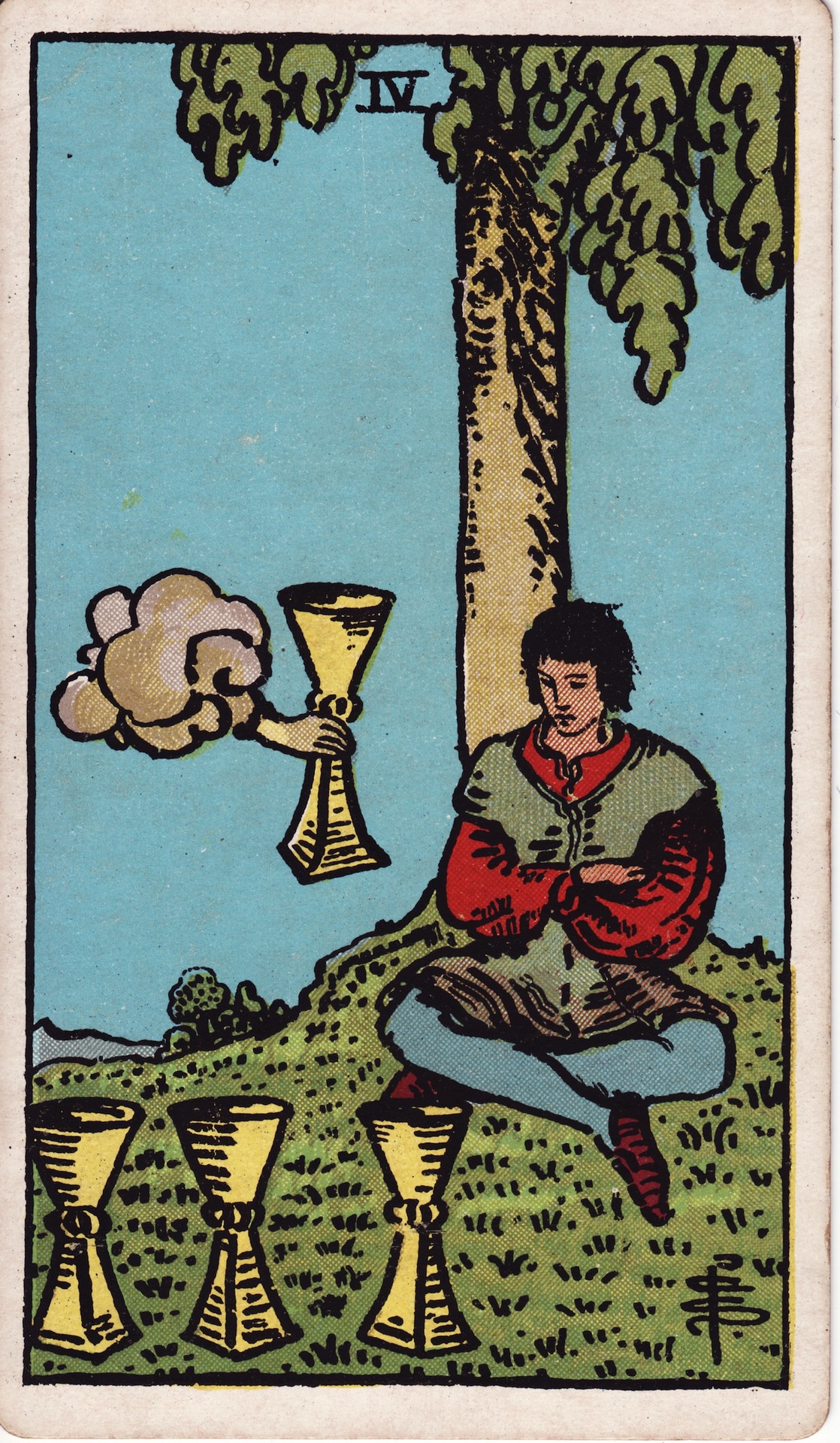
A young man sits cross-legged on a grassy rise with his back against a tree, arms folded across his chest, looking down with a sullen expression. Three golden cups stand in a row on the grass in front of him. From a small cloud at the left, a hand reaches out and offers him a fourth cup, but he does not seem to notice it, or does not care to. Beyond the hill there is only a glimpse of distant country under a plain blue sky.
Four is the number of stability and structure, and in the watery suit stability can turn into stagnation: feelings settled so firmly that nothing new can enter. Waite described the young man as discontented with his surroundings, "as if the wine of this world had caused satiety only."1 The folded arms read as a guard as much as a sulk, a body closed against whatever comes next. His downcast gaze can also be taken as deep thought rather than mere gloom, a mind turned inward and busy with its own questions.2
Upright
The Four of Cups is the card of apathy, boredom, and withdrawal. Nothing is exactly wrong; there may even be plenty on hand. But it has stopped satisfying, and the mind has turned inward to brood. Waite's meanings are weariness, disgust, aversion, and "imaginary vexations," a discontent that is partly self-made.1 The cup offered from the cloud is the important detail: something new is available, and the person in the card is too absorbed to see it.
Not every refusal here is a mistake, though. Sometimes the cup is turned away because your hands are already full, and choosing not to take on one more commitment that does not fit where you are headed is good judgment rather than apathy. The young man also has not pushed the cup away; it simply hangs there, which suggests an answer of "not yet" more than "never." You may be waiting for more information, or for a sense that the offer is right and that you could stay with it for the long haul.2
In love, it can describe a relationship that has gone flat, or someone who keeps turning down chances to meet people because none of them seem worth the effort. Often that reluctance is armor: after a painful breakup or a setback at work, it can feel safer to want nothing than to risk the same hurt again, even if that means letting a good match go by.2 It can also point to emotional withholding, one partner simply checked out. At work, it is the card of the job that no longer engages you, of tasks done on autopilot, and of opportunities passed over without real thought. With money, there may be enough, yet no pleasure in it.
The card is not purely negative. Stepping back to reassess can be wise, and some withdrawal is a healthy response to overload. Clearing room inside, and getting your footing in a new chapter of life, can be what lets you accept the right offer later with your whole heart. Muting the outside noise, the news feed and everyone else's opinions, helps you hear what you actually feel and find a reason behind your days again.2 The question is whether the reflection is leading anywhere. If it is, let it run its course; if not, look up and take a second look at what is being offered.
Reversed
Reversed, the Four of Cups usually shows the spell breaking. The figure under the tree looks up at last, notices the cup that has been held out, and is ready to engage again. Waite's reversed meanings fit this turn: novelty, presage, new instruction, new relations.1 After a period of boredom or low mood, interest returns; you may take up a new course of study, accept an invitation, or say yes to something you would have ignored a month ago.
In love, it can mean returning to dating after a long pause, or a relationship waking up from routine. At work, it favors fresh motivation, a new project, or the decision to finally leave a role you have outgrown.
Some readers turn this around and read the reversal as a deeper retreat, though not necessarily a bad one. It can describe a deliberate season alone, staying home with a book or a quiet practice while you work out what really steadies you. If so, there is no need to drag yourself out before you are ready; this is a phase, not a permanent hermitage. Just tell the people who care about you that you are taking some time, so your absence does not read as indifference. And if an offer is waiting while you think, find out how long it will stay open.2
There is also a less hopeful reading. The withdrawal can deepen instead of lifting, turning into isolation, a stubborn refusal of help, or sulking that has become a habit. Sometimes the world simply feels too heavy, and hiding becomes a way of hoping problems will settle themselves, which they rarely do. In a relationship it can show someone keeping their feelings locked up and pulling away rather than saying what is in their heart, without much thought for how that lands on the other person.2 If that is the case, the advice is gentle but firm: the offer will not wait forever, and the first step toward accepting it is admitting that you want something to change.
Notes
- A. E. Waite, The Pictorial Key to the Tarot (1911), Four of Cups, https://sacred-texts.com/tarot/pkt/index.htm
- Biddy Tarot, "Four of Cups Tarot Card Meanings", https://www.biddytarot.com/tarot-card-meanings/minor-arcana/suit-of-cups/four-of-cups/