Judgement (XX)
Appearance
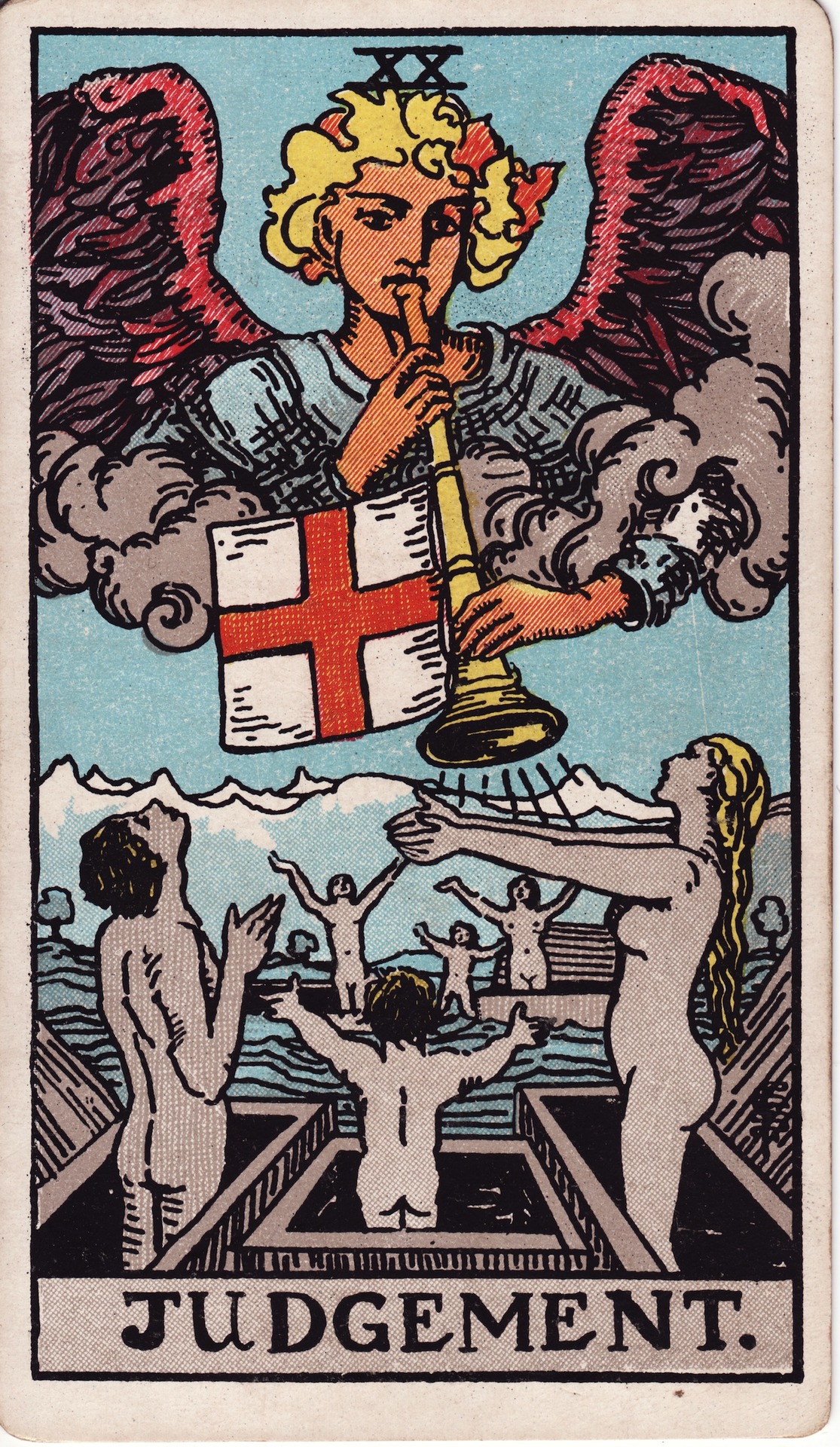
A great angel with red wings leans down out of the clouds and blows a long golden trumpet, from which hangs a white banner bearing a red cross. Below, pale naked figures rise from open coffins that rest in the water, with a line of snowy mountains behind them. In the foreground a man, a woman and a child stand up from their coffins, the man with his hands joined, the woman with her arms reaching toward the angel, and the child, between them, with its back to the viewer. More figures rise farther off, arms spread wide in the same gesture.
Waite called the design essentially unchanged across Tarot decks, and noted that all the figures share one attitude of "wonder, adoration and ecstasy."1 For him the card records a great work of transformation, made in answer to a summons that "is heard and answered from within."1 Its older title is the Last Judgment. The angel is usually taken to be Gabriel, the bearer of messages, and the mountains closing off the horizon can be read as a reminder that there is no route around this moment, only through it.2
Upright
Judgement is the card of awakening and reckoning: a call that cannot be ignored, a moment when the past is reviewed and you rise into a new stage of life. Waite's meanings are change of position, renewal and outcome.1 Often the awakening is a spiritual one, a sudden sense that you are meant for more than the life you have been living, and the card asks you to leave the older version of yourself behind and step up to meet it.2
It often appears when a decision is due, and a weighty one, the kind of fork in the road whose effects last for years. This is not the cool, rule-based weighing of Justice; here the answer comes from heart and head together, and when it will not come, the lessons of your own history are the best guide.2 You weigh what you have done honestly, forgive what needs forgiving, and answer a summons to something larger.
In love, it can mark a turning point: deciding whether to recommit or move on, reconciling after a long separation, or seeing a relationship clearly for the first time. For someone single, it may be a sense that old patterns are finished and you are ready for something different. At work, it points to a calling, a career change that feels inevitable, or an evaluation such as a review, an exam or an interview. With money, it favors clear accounting and decisions based on lessons learned. Waite also records an older reading of total loss through a lawsuit, worth remembering when legal matters are involved.1
On a personal level, Judgement is about self-assessment without self-punishment. You look back honestly, take the lesson, and let the old self be laid to rest. When it goes well, scattered experiences finally make sense as a single story, old wounds close, and the release from guilt feels like a clean slate.2 Notice too that nobody in the picture rises alone. The card can suggest that a group of people who have been through the same thing, a support circle or a community, will help you get up.2 The trumpet sounds; the card asks you to hear it and stand up.
Reversed
Reversed, Judgement shows the call ignored or not yet heard. You may be avoiding a decision, refusing to look honestly at the past, or doubting yourself so much that you will not act on what you already know. Waite's reversed meanings name this directly: weakness, pusillanimity, simplicity.1 The trumpet has sounded, but the figure stays in the coffin. Often the reluctance has a reason: fear of what answering would cost, or of being seen in a larger role. Going on as if nothing happened rarely works, because a real calling tends to grow more insistent the longer it is put off.2
It can also show harsh self-judgement: replaying old mistakes, punishing yourself for things long past, or fearing the judgement of others so much that you never move. One practical way to handle that critical inner voice is to treat it as something separate from you, even give it a name, listen to what it is afraid of, and answer it calmly rather than obeying it.2 In relationships, this can look like holding a grudge, refusing to forgive, or repeating an old pattern because changing it means admitting it was wrong. At work, it may mean ignoring a calling for something safer, or missing an opportunity through hesitation.
Waite adds a second reversed sense, deliberation, decision and sentence, which brings the card back to judgement in the formal sense: a verdict still being weighed or about to be delivered.1 Either way, the reversal asks for honest reflection and some kindness toward yourself. Quiet time, whether meditation or just solitude, can reveal the themes that keep repeating in your life, including mistakes you have hidden out of fear of how others would see them, and naming them is the start of forgiving them.2 Learn what you can from the past, put the rest down, and listen for the call again.
Notes
- A. E. Waite, The Pictorial Key to the Tarot (1911), The Last Judgment, https://sacred-texts.com/tarot/pkt/index.htm
- Biddy Tarot, "Judgement Tarot Card Meanings", https://biddytarot.com/tarot-card-meanings/major-arcana/judgement/