King of Pentacles
Appearance
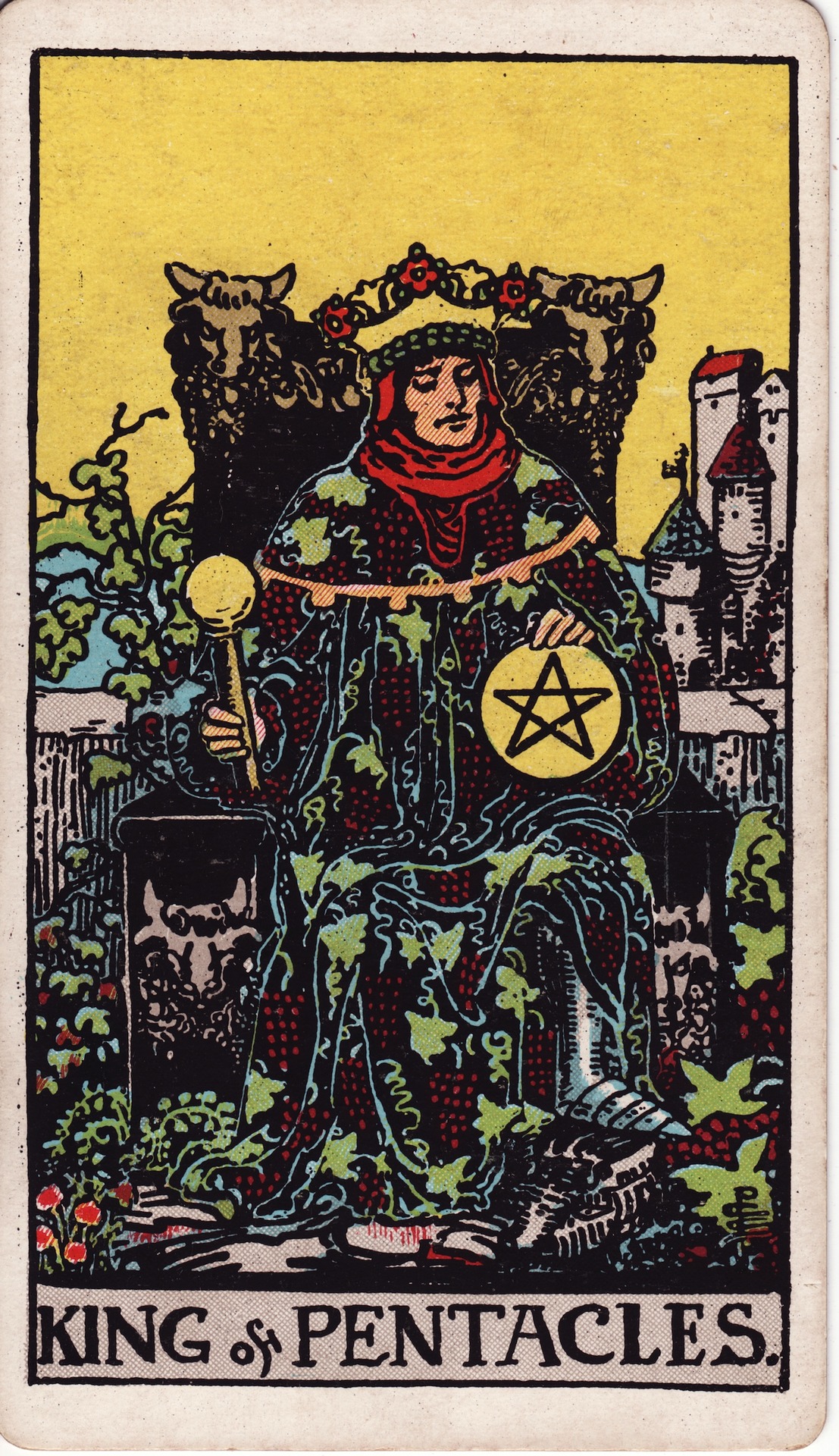
A king sits on a dark throne carved with bulls' heads, two on the back and another on the arm. He wears a crown wreathed with red flowers and a long dark robe covered with a pattern of green vine leaves and grapes, so that he seems to merge with the garden around him. In his right hand is a golden scepter topped with an orb, and his left hand rests on a large pentacle balanced on his knee. An armored foot shows beneath the hem of his robe. Behind him a stone wall encloses the garden, and a castle rises on the right under a yellow sky.
Waite noted the bull's head as "a recurrent symbol on the throne," and wrote that the pentagram on the coins stands for the four elements in human nature and the power that governs them.1 The bulls also tie the king to Taurus, the patient earth sign most concerned with possessions.2 The grapes on his robe and the plants crowding his feet show a harvest at its fullest, and the castle is what he has spent his life building.2 Kings rule their suits outwardly; this one rules the material world.
Upright
The King of Pentacles is the card of material mastery. He has built something lasting through discipline and good judgment, and he now enjoys and protects it. Waite's meanings are valor, intelligence, business, mathematical gifts, "and success in these paths."1 His wealth is not luck but the product of long, careful work. Unlike the Page and Knight of his suit, he is past the striving stage and has nothing left to prove; he can relax into what he has made.2
With money, he is one of the strongest cards in the deck: financial security, abundance, sound investments, and the ability to manage wealth wisely. At work, he points to success in business, leadership, ownership, and senior positions, especially in finance, property, or any field that rewards practical skill. His gift is turning an idea into something you can stand on: he plans, gathers what he needs, and follows through, where others stop at the idea.2 He can also mean the completion of a long-held goal or venture, and the reward is often more than financial, a full and settled life in every sense.2 His advice here is conservative on purpose: you have already learned through trial what works for you, so keep doing it and skip the gambles.2
As a person, the king can represent a successful businessperson, an entrepreneur, a mentor, or anyone who is reliable, generous, protective, and grounded. An older reading Waite records describes "a merchant, master, professor."1 He is often the fatherly figure people go to for practical counsel about money and careers, and his sense of his own worth comes partly from being able to provide for and share with others.2 There is pride in him too; he likes his achievements to be seen.2 In love, he is a devoted and stable partner who shows care through provision and loyalty, and the card can signal a relationship that offers lasting security. On the inner level, the king asks you to take ownership of your resources and your life, to lead with steadiness, and to build things that will outlast the moment.
Reversed
Reversed, the king's mastery turns to misuse. Waite's reversed meanings are vice, weakness, perversity, and peril, and an older reading he records gives "an old and vicious man."1 This is the king who has become greedy, corrupt, or obsessed with status, who measures everything in money and uses wealth to control others. Status can show up socially as well: fawning over people who seem important, brushing off those who do not, and dropping names to look bigger.2
With money, the reversed king can mean poor financial decisions, reckless investment, debt, or a business that fails through bad management. A common version is the high earner who never keeps anything, with each paycheck spent on luxuries or risky bets almost as soon as it lands; the fix is to save some of it while still allowing yourself to enjoy the rest.2 It can also show the opposite extreme: rigid stinginess, an inability to enjoy or share what has been earned. At work, it may point to a domineering boss, corruption, ambition that cuts ethical corners, or plain overwork that crowds out family, health, and friends.2
As a person, he can be materialistic, stubborn, controlling, or ruthless in business, someone whose success has made him hard. In love, he may be a partner who offers money in place of affection, or who treats a relationship as one more possession. The stubbornness can turn on you as well: a life so orderly and predictable that it has gone gray, where a little spontaneity and less seriousness would do more good than another plan.2 On the personal level, the reversed king asks whether your relationship to wealth and work is serving you, or whether you have begun to serve it, and whether security has become an excuse to stop growing.
Notes
- A. E. Waite, The Pictorial Key to the Tarot (1911), King of Pentacles, https://sacred-texts.com/tarot/pkt/index.htm
- Biddy Tarot, "King of Pentacles Tarot Card Meanings", https://www.biddytarot.com/tarot-card-meanings/minor-arcana/suit-of-pentacles/king-of-pentacles/