Page of Wands
Appearance
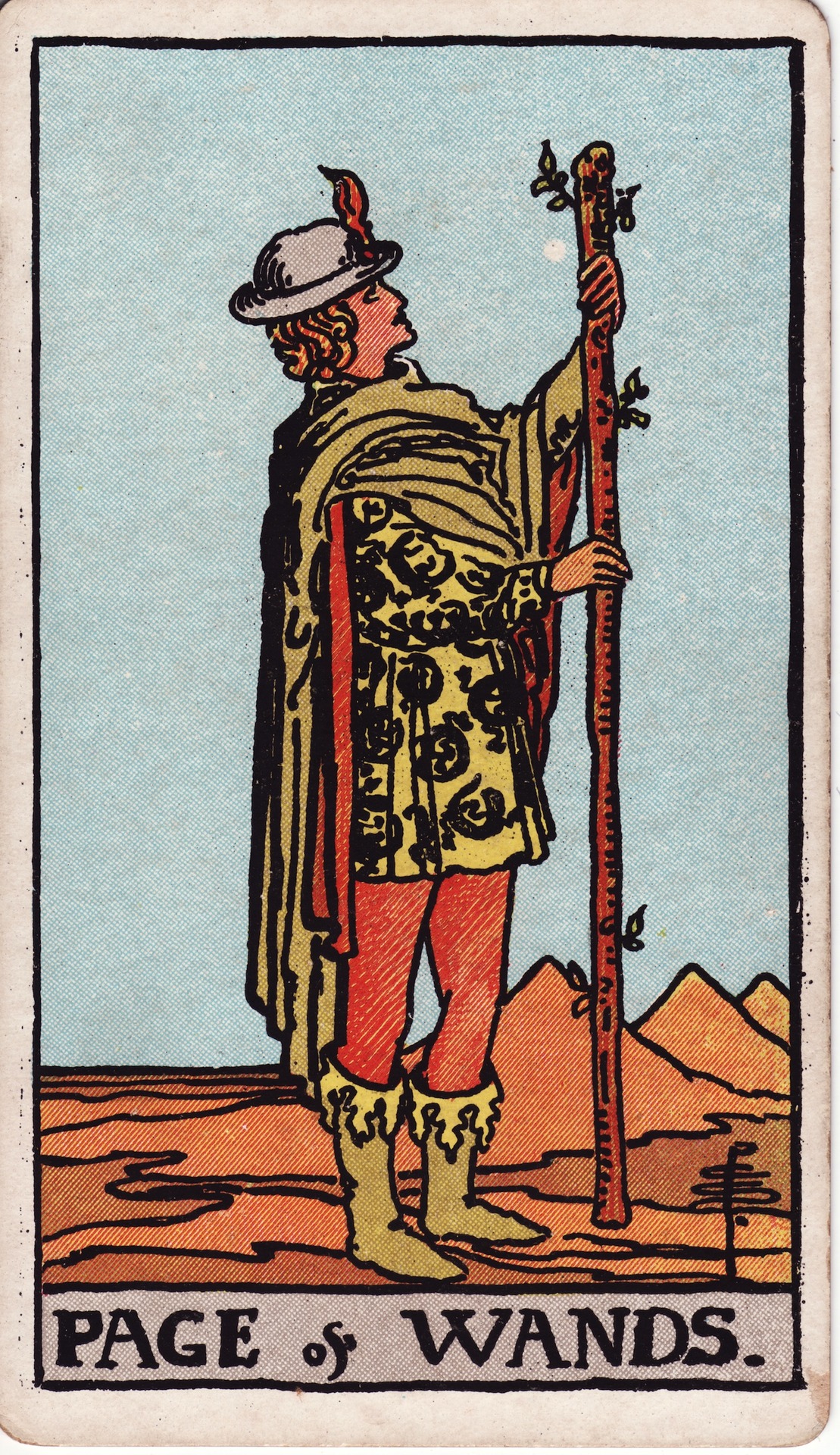
A young man stands alone in a desert, holding a tall wand upright with both hands and gazing up at its sprouting top with evident interest. He wears a gray hat with a red feather, a long cape, and a yellow tunic patterned with dark curling salamanders, the fire creatures of this suit, over red hose and boots with flame-shaped tops. Behind him, three pointed hills or pyramids rise from the sand under a pale sky, the same hot, dry country that appears behind the Knight.
Pages are the students and messengers of their suits. Waite set this one in a scene like that of the Knight and described him in the act of proclamation: unknown but faithful, and his tidings are strange.1 The salamanders, said to live in flame without burning, point to change by fire as much as to fire itself. The foot of the wand rests on the ground and the Page has not moved off with it; he is taken with what it might become but has not acted on it.2 Nothing else grows in that empty land, and he is the one who noticed the live shoot where others would see only sand.2
Upright
The Page of Wands is the card of enthusiasm and the first stirrings of a new passion. Something has caught your interest and you want to explore it: an idea, a place, a skill, a direction. The energy is fresh and eager, though not yet tested. There is often no plan and no clear destination, only a willingness to try almost anything once and see where it goes.2 Waite gives the card the chief qualities of its suit, and lists the Page as an envoy, a messenger, and a bearer of family news.1
As a person, the Page is often a young or young-at-heart person who is curious, adventurous, expressive, and full of plans: a student, an apprentice, a newcomer who brings energy into the room. Waite calls him faithful and a lover, and says that beside a man he will speak well of him.1
At work, the card favors trying something new: a course, a creative project, a first job, or a fresh idea worth pitching. It can also mean good news about work or travel. With money, it encourages exploring opportunities without committing everything at once. The planted wand is a useful reminder here. A spark still has to be brought down to earth before it is ready to act on, so sketch out how it would work, try a small version first, and keep only the ideas that serve where you are actually trying to go.2
In love, it suggests flirtation, playful attraction, and the excitement of early romance, or a new spark in an existing relationship. On a personal level, the Page asks you to follow your curiosity and to treat a beginning as a chance to learn rather than a test you must pass. That curiosity can turn toward the inner life as well: a first real interest in a spiritual practice, approached as a beginner, and helped along by someone further down the same road who is willing to teach.2
Reversed
Reversed, the Page's enthusiasm loses direction. Ideas come quickly but are dropped just as quickly, projects are started and abandoned, and plans lack the follow-through to become real. At work, this can mean creative block, a promising start that fizzles, or impatience with the slow, unexciting parts of learning a skill. It can also mean delayed or disappointing news. Sometimes the trouble starts as early excitement that ran into complications and pushback, leaving you unmotivated, unsure which way to go, and quietly afraid that the new thing will only add to your load. Self-doubt does a lot of the damage at this stage.2
A gentler reading is that the idea is real but not ready. You can feel something forming and cannot yet say what it is, and pushing it into action now would only cramp it. Turn it over, play with it, and let it take shape on its own time.2 If an attempt has already failed, separate the idea from the way you carried it out; the vision may be sound and the method wrong, so go back to what first excited you and look for a different route to it.2
As a person, the reversed Page may be restless, immature, or unreliable: full of big talk, quick to boast, and slow to deliver. In love, it can describe a flirtation that goes nowhere, someone who loses interest once the chase is over, or a partner whose excitement fades after the first weeks. The card can also describe an inward search kept deliberately private, where the answers are expected to come from within rather than from anyone else.2
Waite's reversed meanings include anecdotes, announcements, and evil news, along with indecision and the instability that comes with it; his additional notes say simply bad news.1 The advice is patience: choose one thing, commit to it long enough to see it grow, and let enthusiasm turn into skill.
Notes
- A. E. Waite, The Pictorial Key to the Tarot (1911), Page of Wands, https://sacred-texts.com/tarot/pkt/index.htm
- Biddy Tarot, "Page of Wands Tarot Card Meanings", https://www.biddytarot.com/tarot-card-meanings/minor-arcana/suit-of-wands/page-of-wands/