Six (6) of Pentacles
Appearance
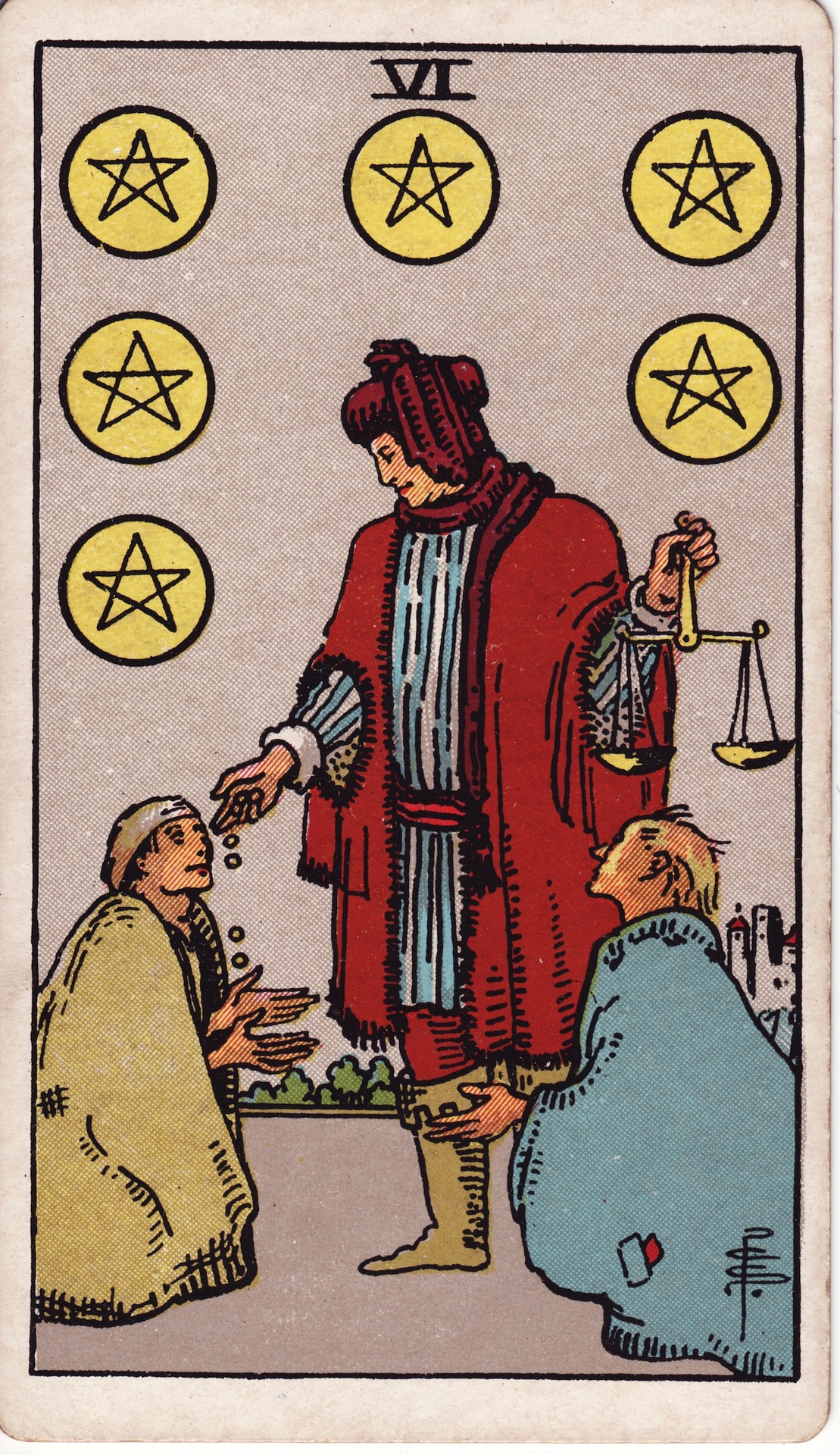
A well-dressed merchant in a red cloak over a striped tunic stands between two kneeling beggars. His left hand holds up a pair of balanced scales; with his right he drops a few small coins into the outstretched hands of the man kneeling on the left. The beggar on the right, wrapped in a patched blue cloak, looks up and reaches toward him, still waiting. Six pentacles float in the gray sky above, and a small town is visible in the distance.
Waite saw the scene as "a testimony to his own success in life, as well as his goodness of heart."1 Six is the number of harmony restored after the upheaval of the five; in this suit, that harmony comes through the exchange and redistribution of wealth. The positions in the picture are not fixed. Over a lifetime most people take a turn at each of them, standing with the scales in one season and kneeling with open hands in another, and the card reminds the comfortable that their own turn to ask may come.2
Upright
The Six of Pentacles is the card of giving and receiving. Resources flow from where there is plenty to where there is need, and the scales suggest that the giving is measured and fair. Waite's meanings are presents, gifts, and gratification, along with attention, vigilance, and the phrase "now is the accepted time," a sign that present prosperity should be used rather than hoarded.1 When it describes your own finances, it often means a healthy balance, with what comes in and what goes out roughly matched, and enough left over to share.2
With money, the card can point to either side of the exchange. You may be in a position to give: to donate, lend, support family, or share what you have earned. The gift need not be cash; an afternoon of your time, some hard-won advice, or simply showing up for someone can matter as much to them as a check, and it is fine to trust that what you put out finds its way back.2 If you lend to a friend or relative, treat it as a bridge rather than a destination, and think about help that leaves them able to stand on their own.2 Or you may be the one receiving: a loan, a grant, a gift, an inheritance, financial aid, or a debt finally repaid. That can bring real relief, but the aim is to use the help to recover, return the favor later in money or in kind, and avoid coming to depend on it.2 At work, it can mean fair pay, a bonus, or a mentor generous with time and knowledge. In love, it speaks of a relationship where both partners give and take in balance, and of generosity that is noticed and returned.
The card also invites a closer look at power. The giver stands while the others kneel, and he decides who receives. On the personal level, the six asks whether your giving is free or comes with strings, and whether you can accept help without feeling diminished by it.
Reversed
Reversed, the scales tip. Giving becomes one-sided, or charity becomes a way of holding power over others. This can be the lender who expects too much in return, the employer who underpays, or the partner who keeps careful account of every favor. It can also show the opposite: someone who always gives and never allows themselves to receive, until they are drained. For that person the reversal is a nudge to turn some of the generosity inward, with rest or a small treat that says thank you to yourself.2
Waite's reversed meanings are desire, cupidity, envy, jealousy, and illusion.1 Read this way, the card points to wanting what others have, resenting another's good fortune, or being taken in by a promise of help that never arrives. With money, it warns of debt, unpaid loans, scams, or gifts that turn out to carry obligations. Borrowing is especially risky here, since a small loan can grow with interest into something you cannot manage.2 Nor should someone who is already short give away more than they can spare.2 An older reading he records says simply that the present must not be relied on.1
When a favor or loan has not been returned, you cannot make the other person pay, but you can decide not to lend again, or agree up front on some other form of repayment, such as a shared meal or help with a job, so that the exchange still runs both ways.2 Charity can also become a performance, given to be seen as generous rather than for the sake of the one who needs it.2
In love, the reversed six can describe an unequal relationship, where one person supplies the money, care, or attention and the other only takes, or where the same partner always gives way.2 On the inner level, it asks you to examine what you expect when you give, and whether you are offering help or buying approval.
Notes
- A. E. Waite, The Pictorial Key to the Tarot (1911), Six of Pentacles, https://sacred-texts.com/tarot/pkt/index.htm
- Biddy Tarot, "Six of Pentacles Tarot Card Meanings", https://www.biddytarot.com/tarot-card-meanings/minor-arcana/suit-of-pentacles/six-of-pentacles/