Six (6) of Swords
Appearance
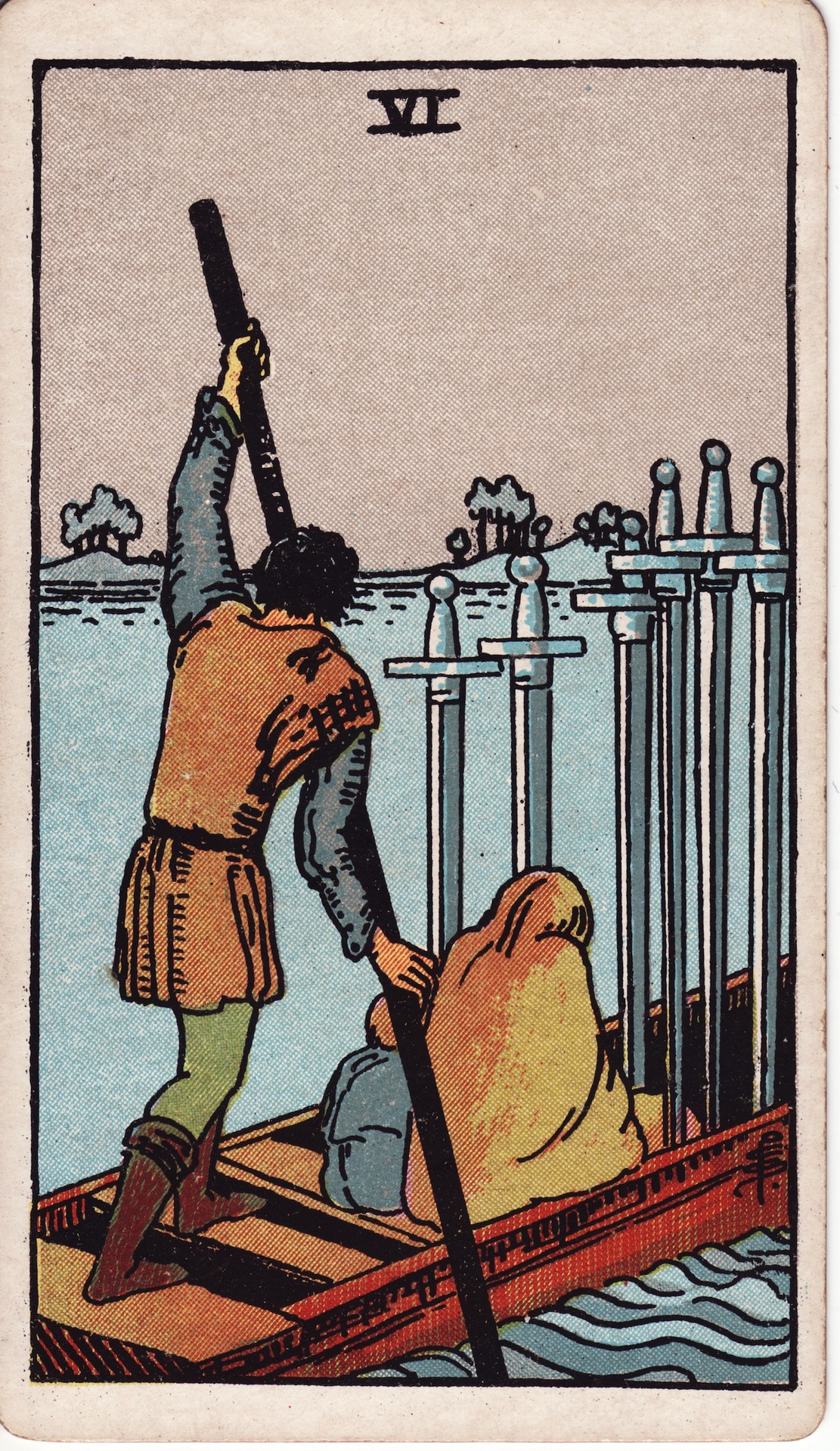
A ferryman stands at the stern of a flat boat, pushing it forward with a long pole. Seated in front of him is a hunched figure wrapped in a hooded cloak, with a smaller figure huddled at their side, often read as a woman and child. Six swords stand upright in the boat, planted in its floor. On one side of the boat the water is ruffled, while the water farther out lies smooth, and on the far shore a low line of trees waits. All three figures face away from us, toward where they are going.
Waite described the course as smooth and the freight as light, so that the work is not beyond the ferryman's strength.1 Six is a number of harmony and adjustment after the strife of five; here it takes the form of a passage away from trouble. The woman's covered head reads as mourning for whatever is being left, and the child pressed close to her is looking for shelter on the way. The swords are cargo: the passengers have left the place, but they are bringing its memories along with them.2
Upright
The Six of Swords is a transition: leaving a difficult situation behind and moving, slowly and quietly, toward something calmer. The passengers are not celebrating. They carry their burdens with them, but the boat is moving, and the worst is at their backs. Waite's meanings are a journey by water, a route, a way, an envoy, and an expedient, and his additional notes promise that the voyage will be pleasant.1 The move may be one you chose or one that was decided for you, and either way it is normal to grieve what was familiar; that sadness tends to give way, over the crossing, to a clearer head and a more settled acceptance of the change.2
In love, it can describe moving on from a painful relationship, or a couple leaving a troubled period behind and finding steadier ground together. It can also mean a literal move, with someone or for someone. At work, it points to changing jobs, relocating, or getting a project out of crisis and into calmer water. With money, it suggests gradual improvement after a hard stretch, not a windfall but a slow recovery. Getting there may take some hard calls and a few compromises, and it helps to treat them as part of the passage rather than as signs that it is going wrong.2
The card is often about travel, especially across water. On the inner level, it is the quiet decision to stop fighting the old situation and go, and a chance to revise what you believe about yourself, steering away from the person you were and toward the one you mean to become.2 Those six swords are worth an inventory: old habits, beliefs, grudges, and ties all add weight to the boat, so sort out which ones are coming with you and which can stay on the shore you are leaving.2 Help may come from someone like the ferryman, a guide or friend who steers while you rest. Healing here is a process; you do not have to arrive all at once.
Reversed
Reversed, the journey is delayed, interrupted, or refused. You may be unable to leave a situation you know you need to leave, or you may leave physically while carrying all of the old trouble with you. Sometimes the crossing is attempted and turned back by rough water: plans to move or change jobs stall, or a recovery that seemed underway falters. Often the delay is a quiet stalling, waiting for the problem to fade by itself or insisting it is bearable when you already know it is time to go. The discomfort of pushing past that is usually a sign that growth is underway, not that you are wrong.2
In relationships, this can mean returning to an old pattern, staying out of fear of the unknown, or running from one hard situation straight into another. At work, a transition may be messier than expected, or unresolved business may follow you into the new role. Resistance can also come from feeling that a move was imposed, as when a partner's job means relocating and you had little say. The way through is to find what you yourself stand to gain from it and how it fits your own values.2
The reversed card can also describe a crossing made alone and out of sight: an inner or spiritual shift away from a belief, a habit, or a relationship, worked through privately with little outward sign that anything is changing.2 Waite's reversed meanings are different in kind: declaration, confession, and publicity, with one account he cites giving a proposal of love.1 Here something kept private comes into the open. His additional notes also give an unfavorable outcome to a lawsuit.1 On the inner level, the reversed card asks what you are still carrying that you could set down, and whether the resistance to moving on comes from outside or from within. If the past keeps pulling you back, look for an unsettled conflict or a lesson not yet learned, since those tend to need finishing before you can go forward wholeheartedly.2
Notes
- A. E. Waite, The Pictorial Key to the Tarot (1911), Six of Swords, https://sacred-texts.com/tarot/pkt/index.htm
- Biddy Tarot, "Six of Swords Tarot Card Meanings", https://www.biddytarot.com/tarot-card-meanings/minor-arcana/suit-of-swords/six-of-swords/