Temperance (XIV)
Appearance
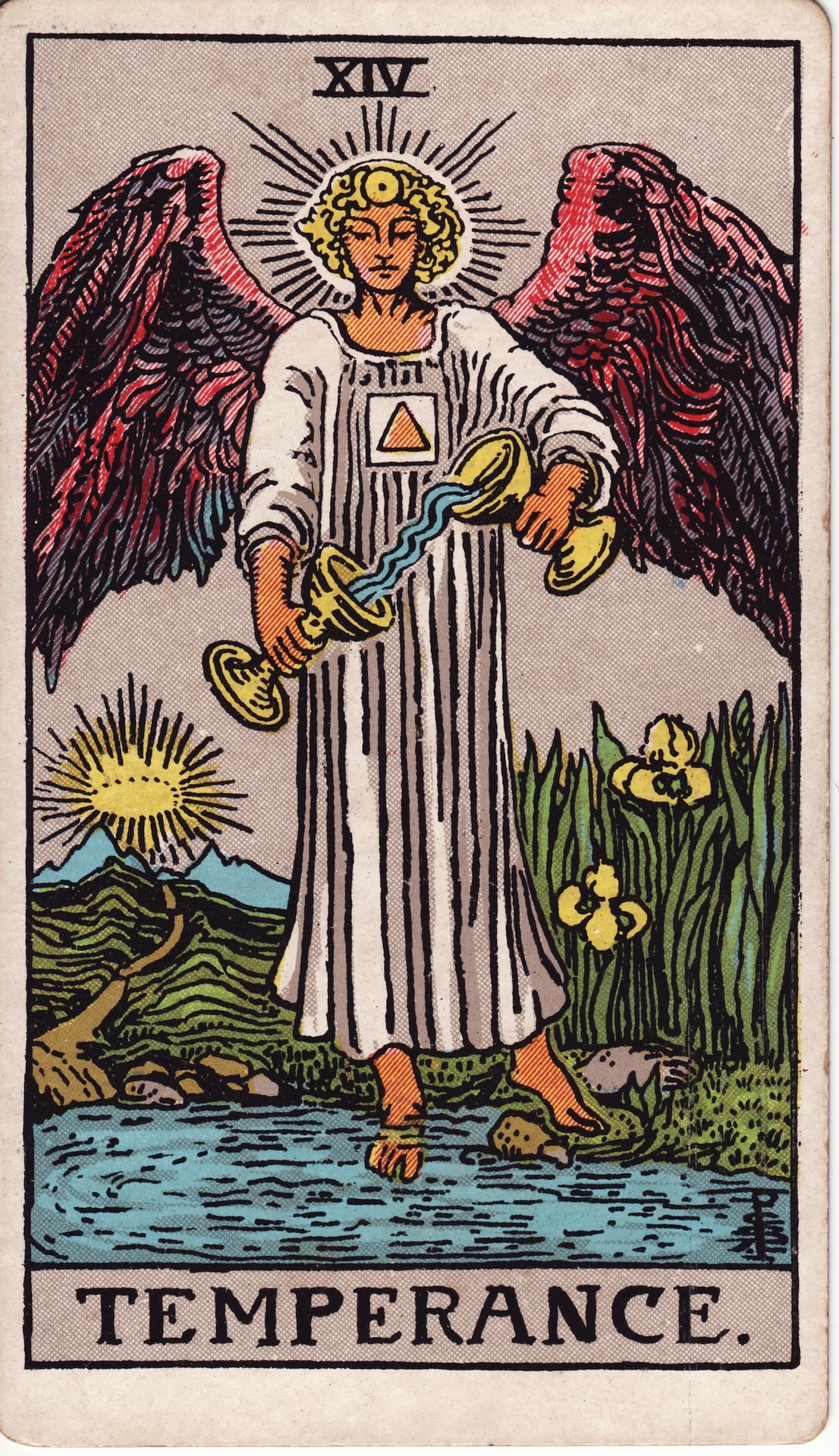
A winged angel in a white robe stands at the edge of a pool, one foot in the water and the other on a stone at the bank. A golden disc is marked on the forehead, and on the breast of the robe is a square enclosing a triangle, with Hebrew letters of the divine name above it. The angel pours water from one gold cup into another. Yellow irises grow to the right. To the left a path climbs from the water toward blue mountains, where a bright light rises like the sun.
Waite noted that the angel is neither male nor female and described it as pouring the essences of life from chalice to chalice, one foot on earth and one on water. In the light above the path he saw a crown, vaguely. The card is called Temperance, he said, because where its rule holds it "tempers, combines and harmonizes" the psychic and material natures.1 Modern readers see the triangle in the square as spirit held within earth's laws, the stone as being grounded and the water as staying in motion, and the path up to the crown as the road to a life's purpose.2
Upright
Temperance is the card of balance, moderation and patient blending. Rather than choosing one extreme, it brings opposites together in the right measure and lets time do its work. Waite's meanings are economy, moderation, frugality, management and accommodation: practical virtues, none of them dramatic, all of them about finding the middle path and staying on it.1 In daily life that often looks like an even temper when everything around you is hectic, small annoyances passing without a reaction, and that steadiness serving as the ground for a satisfying life rather than a sign of not caring.2
The card has an alchemical side as well. Mixing here is creative: two things combined with care become a third thing worth more than either, as in a blended family, a painter working across media, or a cook who marries two cuisines.2 With other people, it casts you as the peacekeeper. This is a poor moment for hard-line opinions; hear every side, draw different kinds of people together, and let the mix of their abilities carry the work.2
In love, Temperance describes a relationship in which two people adjust to each other, compromise without resentment, and build something steady. It favors healing after a conflict, and calm, unhurried growth over intensity. For someone single, it suggests finding balance on your own first, so that a new relationship starts from steadiness rather than need. At work, it points to progress made through consistent effort instead of sudden pushes. With money, it is a direct counsel of moderation: budget, save, and avoid both stinginess and excess.
The inner meaning is integration. The angel moves the water between the cups without spilling it, and the card asks you to bring the different parts of your life, work and rest, desire and duty, into proportion. Patience is part of the lesson; the right mixture takes time to settle. The card often appears when you already know where you are headed and feel no need to hurry, and it can mark a stretch of real learning in which things are quietly coming together and your own inner guidance deserves to be trusted.2
Reversed
Reversed, Temperance shows balance lost. Something has tipped into excess: overwork, overspending, overindulgence in food, drink or distraction, habitual arguing or gloomy thinking, or simply a life that leans too far one way. It can also describe impatience, wanting results immediately and abandoning the steady approach that would have delivered them. Moderation is the usual cure, but not always; when a habit has hardened into a cycle, giving it up entirely may be the surer way back to balance.2
Waite's reversed meanings move away from personal moderation and toward conflict: disunion, unfortunate combinations, competing interests.1 In relationships this can point to clashing priorities, arguments that never settle, or two people pulling in different directions. At work, it may show a team that cannot cooperate or a partnership whose parts do not mix. Waite also lists matters connected with churches and the priesthood, an old reading rarely emphasized now.1
The reversal can be quieter, too: a persistent sense that something is off and that life has stopped flowing. Ignoring that feeling rarely works, since it tends to grow more insistent until it is dealt with; the better course is to steer daily choices back toward your longer aims.2 It can also mark a time of reassessment, when what you feel drawn to inwardly no longer matches how you spend your days. Closing that gap may mean changes to home, relationships, work or routine, and some friction along the way is part of the process rather than a sign that you have gone wrong.2
On a personal level, the reversed card is a prompt to notice where you have lost your center and to restore proportion slowly rather than swinging to the opposite extreme. Some readers also see in it a healing turned inward, done privately and on your own terms, drawing on what you already have rather than on anyone else.2
Notes
- A. E. Waite, The Pictorial Key to the Tarot (1911), Temperance, https://sacred-texts.com/tarot/pkt/index.htm
- Biddy Tarot, "Temperance Tarot Card Meanings", https://www.biddytarot.com/tarot-card-meanings/major-arcana/temperance/