Ten (10) of Pentacles
Appearance
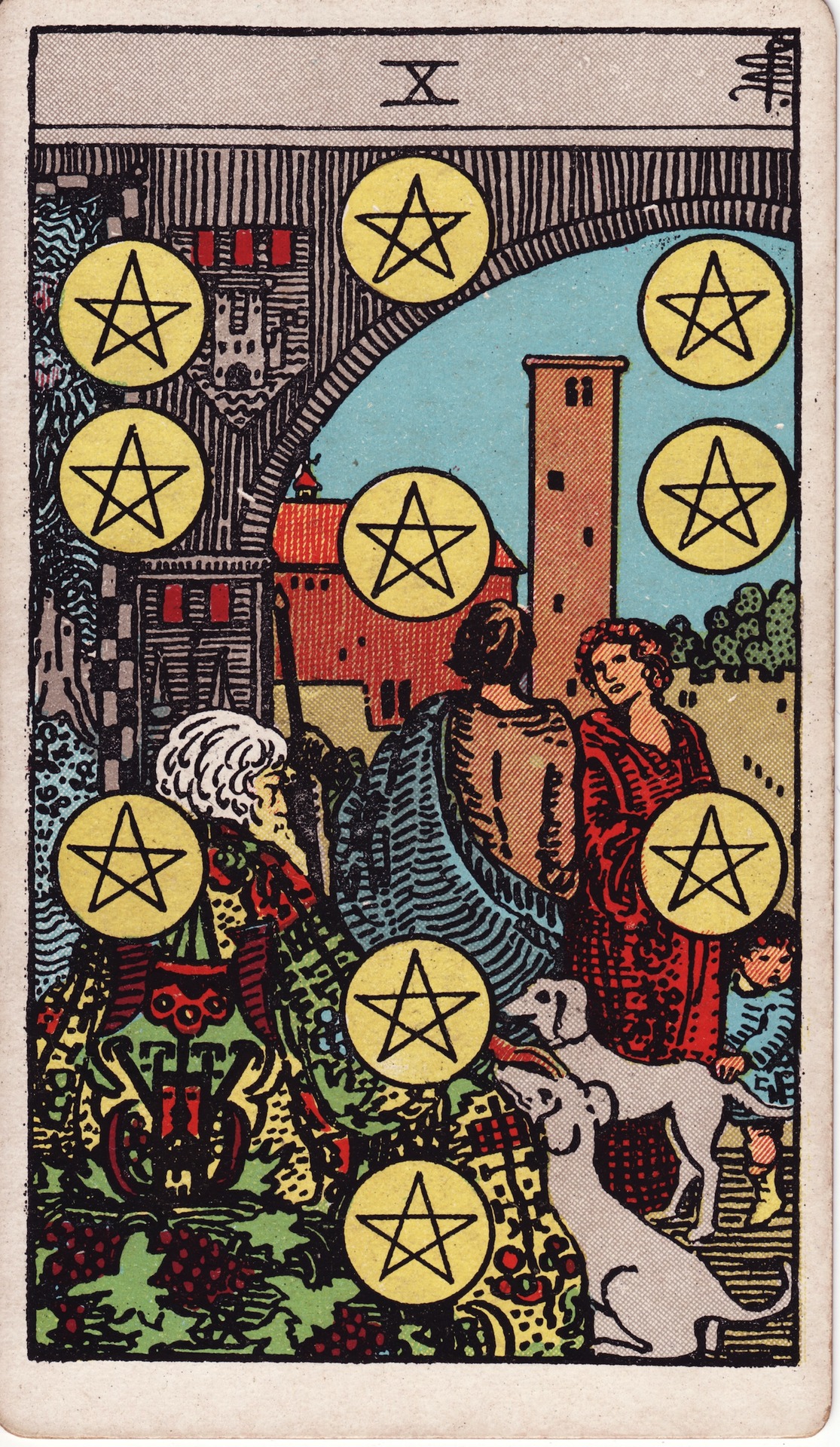
An old man with white hair and beard sits in the foreground, wrapped in a richly patterned robe embroidered with grapes and other designs. Two white dogs nuzzle at him. Beyond him, a stone archway marked with carved coats of arms opens onto a town with red-roofed buildings and a tall tower. Under the arch stand a younger man, seen from behind and holding a spear, and a woman in red who turns her head toward him. A small child peeks out from beside her, one hand resting on a dog. Ten pentacles are laid over the whole scene.
The pentacles are arranged in the pattern of the kabbalistic Tree of Life. Ten is completion, the end of the suit's journey. Waite's meanings center on "the abode of a family," a house in which wealth passes from one generation to the next.1 The heraldry on the arch says the same thing in stone: this family has a past, a name, and a place in the town around it, and the old man can look at the people near him and see what his life's work has become.2
Upright
The Ten of Pentacles is the card of lasting wealth and of family. Three generations share one scene: the elder who built what they have, the couple who maintain it, and the child who will inherit it. Waite's meanings are gain and riches, family matters, archives, lineage, and the family home.1 This is prosperity measured not in one person's lifetime but across many. As the last card of the suit, it also marks the point where a long effort finally pays off and the separate pieces, career, money, home, and partner, settle into place together.2
With money, it points to long-term security: an inheritance, a family business, a well-funded retirement, property, investments that endure, or financial decisions made with future generations in mind. At work, it can describe a stable, established company, a career built on long service, or a business handed down within a family. It favors thinking in decades rather than quarters, and steady, repeated effort over the quick win.2
Part of the card's pleasure is in providing. Whoever has done the earning gets to watch others live well because of it, and the satisfaction of supporting a household often outweighs the satisfaction of the money itself.2 It also describes a feeling of enough: nothing urgent left to chase, and a quiet gratitude for what has been secured.2
In love, the card speaks of commitment that builds a household: marriage, starting a family, merging finances, or joining your partner's wider family. It can mark a reunion or celebration where generations gather, and a family you can rely on without reservation.2 On the inner level, the ten asks what you have inherited, not only in money but in values and traditions, and what you hope to leave behind. It carries the sense of belonging to a long line, of being one link in something older and larger than yourself.2 Its abundance is quiet: no one in the picture seems to notice the pentacles, because wealth here has become simply the ground they live on.
Reversed
Reversed, the inheritance is disputed or the household cracks. Waite's reversed meanings are chance, fatality, loss, robbery, and games of hazard, an unstable mix of risk and misfortune.1 With money, the card warns against gambling, speculation, or risky ventures that could undo what generations have built. It can point to a failed business, bankruptcy, a property lost, investments that have shed much of their value, or a theft.2 Waite adds that it sometimes means a gift, dowry, or pension, money that comes through family or arrangement rather than effort.1
Most often in modern readings, the reversed ten describes family conflict: disputes over a will or inheritance, arguments about money between relatives, or obligations that weigh more than they support. In love, it can mean a marriage strained by finances, or pressure from family expectations that the couple cannot meet.
A subtler reading treats the reversal as wealth turning into a cage. Each step up in comfort quietly becomes the new floor, a larger house brings larger upkeep, and stepping back down feels impossible even when income falls, so savings drain to keep up appearances. If your sense of your own worth has fused with what you own, the card asks you to pull the two apart.2
At work, it may signal instability in a long-established organization, a job that suddenly feels at risk, or a family business that no longer holds together.2 On the personal level, it asks whether you are carrying traditions that no longer fit you, and whether you value security over the relationships that were meant to make it worthwhile. It can also question the whole settled picture: whether the steady job, the push toward marriage, or the next purchase is something you want or only what is expected of you.2
Notes
- A. E. Waite, The Pictorial Key to the Tarot (1911), Ten of Pentacles, https://sacred-texts.com/tarot/pkt/index.htm
- Biddy Tarot, "Ten of Pentacles Tarot Card Meanings", https://www.biddytarot.com/tarot-card-meanings/minor-arcana/suit-of-pentacles/ten-of-pentacles/