The Lovers (VI)
Appearance
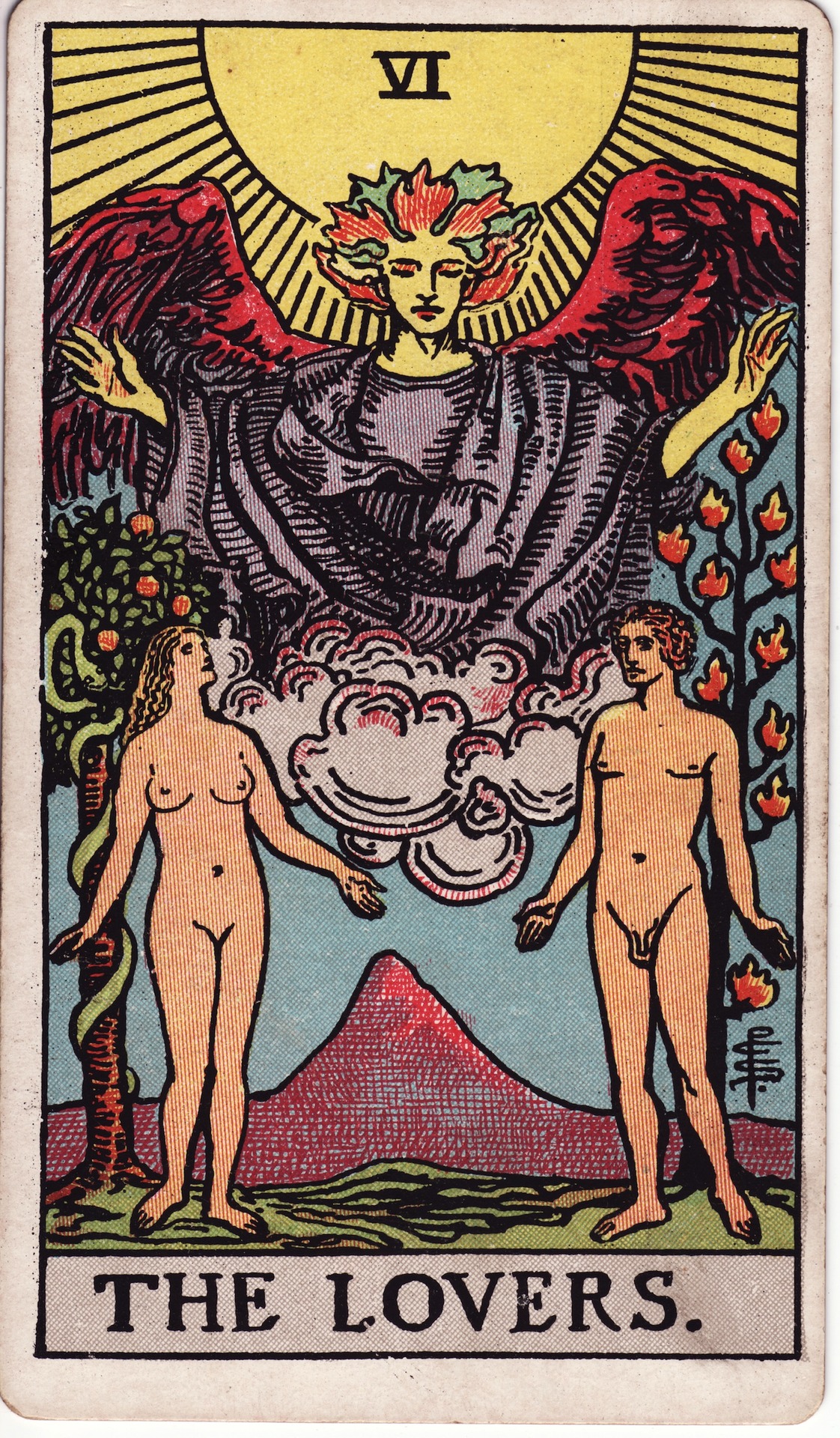
A man and a woman stand naked in a green landscape, with a tall red mountain between them. Above, against a radiant sun, a red-winged angel spreads its arms over them from a bank of clouds. Behind the woman is a fruiting tree with a serpent coiled around its trunk; behind the man is a tree whose branches carry flames. The man looks toward the woman, and she looks up toward the angel.
Waite identified the trees as the Tree of the Knowledge of Good and Evil and the Tree of Life, and saw the pair as Adam and Eve in paradise. His design replaced an older one of a young man between two women, and he called the new image "in all simplicity the card of human love."1 Many readers name the angel Raphael, the healer of body and heart.2 The serpent's tree stands for the pull of the senses away from the sacred; the man's tree burns with desire, its twelve flames sometimes read as the zodiac.2 The gazes climb from bodily want, through feeling, to spirit, and the mountain can be taken as passion about to erupt.2
Upright
The Lovers is the card of love, union and meaningful choice. At its simplest it signals attraction, intimacy and a bond between two people who see each other clearly; Waite's meanings are attraction, love, beauty and trials overcome.1 But the card also carries the older theme of the young man at the crossroads, and many readers treat it as a card of a decision that matters because it reflects your values.
In love, it is one of the strongest cards in the deck: a deepening relationship, a commitment, a soulmate connection, or the moment two people decide to choose each other. The physical side is real, but here it reaches past appetite toward something close to sacred. The couple's nakedness is part of the message: neither is hiding, and trust grows out of that willingness to be seen and to say what is true.2 For someone single, a significant meeting may be near. The card is not only romantic, either; it can describe a friendship or family tie where respect and care run freely.2 At work, the Lovers favors partnerships and collaborations built on shared goals, and it can point to a choice between paths, offers or loyalties that will shape what comes next. With money, decisions should follow your principles rather than short-term gain.
On a personal level, the card asks what you truly value, and whether your choices line up with it. Coming after the Hierophant, it marks the point where the teaching you were handed gives way to beliefs you have tested and claimed as your own.2 Often the choice in front of you is a moral one, and the card asks you to weigh where each road leads and to take the harder, better one rather than act out of fear, guilt or shame.2 It also speaks of reconciling opposites: every option carries gain and loss together, and accepting both is what makes a whole.2 The angel above the couple suggests a love, or a choice, that is blessed because it is made openly and in harmony with something larger than impulse.
Reversed
Reversed, the Lovers points to disharmony, imbalance, or a choice made badly. In relationships, this can mean growing apart, mismatched values, a loss of trust, or temptation that pulls one partner away. Communication breaks down, and each person may feel unseen by the other. One may be far more invested than the other, or someone may be holding back for fear of being hurt.2 Sometimes a rough patch passes if you remember why this person matters to you and meet the moment with patience; sometimes the pair has simply outgrown each other, and steady quarreling and disrespect are the sign to let go kindly.2
The reversal can also describe avoidance of a decision: hoping a choice will make itself, or letting someone else choose for you. It can be the temptation to take a shortcut and dodge the consequences, which the card warns against however safe it seems.2 At work, a partnership may be strained, or a decision may be pulling against your principles for the sake of money or approval. Inwardly, it can signal a conflict between what you want and what you believe is right, or a lack of self-acceptance that makes closeness with others difficult. Envying qualities in other people is a clue here, since what you can recognize in them is usually present in you as well.2 If you are punishing yourself over something past, spell out what you actually believe so it can guide the next choice, and consider asking a mentor or teacher for counsel.2
Waite's reversed meanings are failure and foolish designs, and another account adds marriage frustrated and contrarieties of all kinds.1 The remedy is to be honest about what you value, to talk openly, and to choose deliberately rather than drift.
Notes
- A. E. Waite, The Pictorial Key to the Tarot (1911), The Lovers, https://sacred-texts.com/tarot/pkt/index.htm
- Biddy Tarot, "The Lovers Tarot Card Meanings", https://www.biddytarot.com/tarot-card-meanings/major-arcana/lovers/