The Tower (XVI)
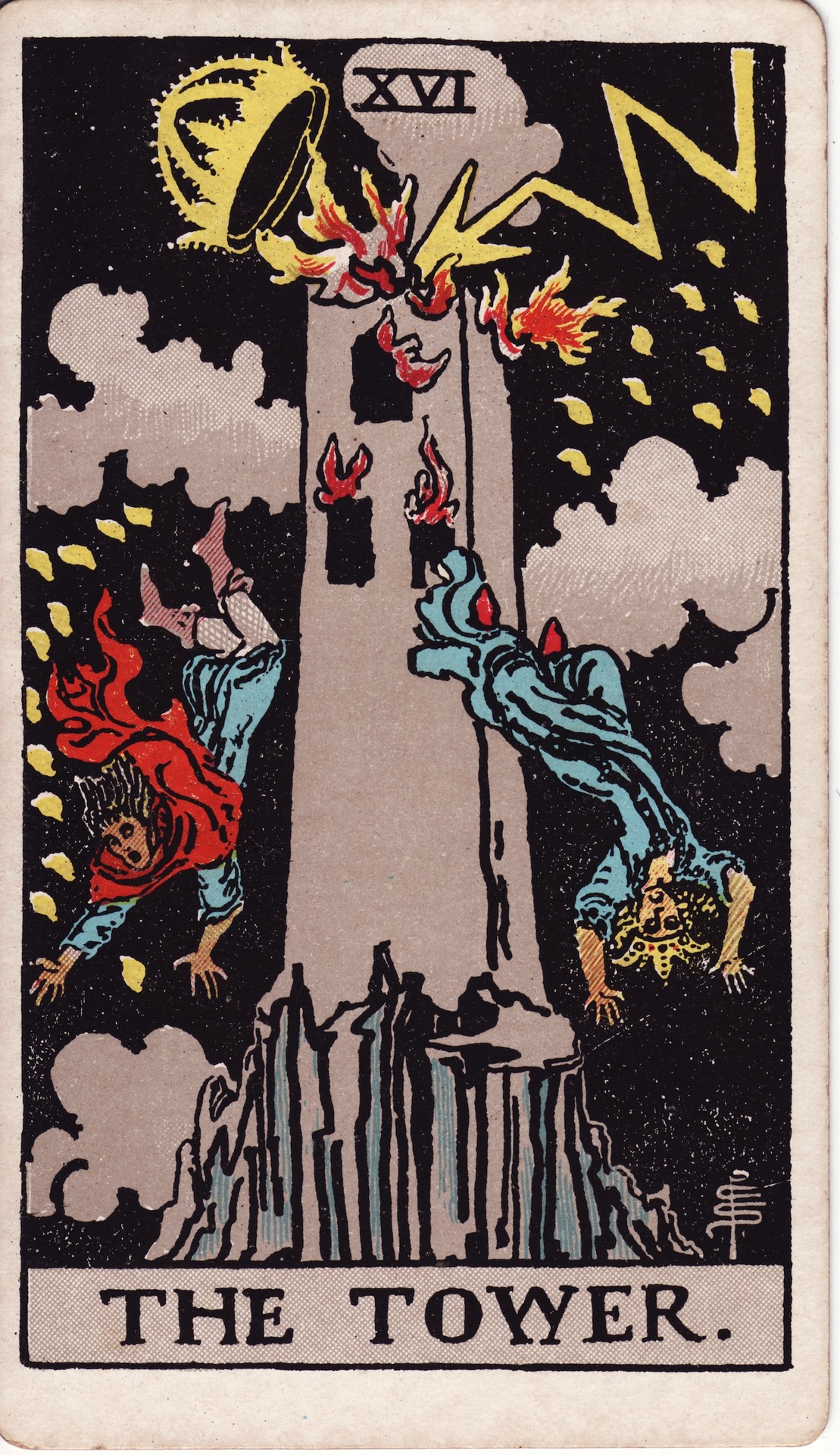
Appearance
A tall gray tower stands on a jagged peak against a black sky. A bolt of lightning strikes its top and knocks off the crown that served as its roof, and flames burst from the windows. Two people fall headfirst with their arms outstretched: one in a red cloak and blue robe, the other wearing a crown. Around them drop small yellow flames shaped like the Hebrew letter yod, and gray clouds hang on either side.
The stone is solid but rests on a bare crag, so one strike undoes it, like an ambition raised on a false premise.1 The bolt enters at the crown, insight forced in from above. Some read the twenty-two yods as the twelve zodiac signs plus the ten sephiroth of the Tree of Life: grace amid the wreck.1
Waite found the occult explanations of this card thin, since ruin in all its aspects is plain on its surface. He preferred to read it as the ruin of the House of Life when evil has prevailed there, and above all as the destruction of a house of doctrine built on falsehood.2 Older titles include the House of God and the Tower of Babel.
Upright
The Tower is the card of sudden upheaval. Something that seemed solid collapses, often without warning: a structure, a plan, a belief, a relationship, a job. Waite calls it a card "of unforeseen catastrophe" and lists misery, distress, adversity, calamity, disgrace and ruin.2 It is among the most feared cards in the deck and is rarely comfortable, but what it destroys was usually built on a weak foundation to begin with. The blow tends to land just as things finally felt settled, and it can shake body, mind and spirit at once.1
In love, it can mean a shocking revelation, a sudden breakup, or an argument that drags long-hidden problems into the open. For someone single, it might be a disillusionment that clears away a fantasy. At work, it points to sudden job loss, a company restructuring, a project that fails outright, or a crisis that exposes what was never working. With money, it warns of unexpected loss or expense; check where you are overextended. It can also stand for a health scare, a bereavement, or damage from storm or fire, any event big enough to rattle everything else at the same time.1
The deeper reading is about truth breaking through. Lightning illuminates as it strikes, and the Tower often brings a moment of clarity that no one would have chosen but no one can unsee. Assumptions you leaned on, and stories you let yourself believe, turn out to be false, and for a while it can be hard to tell what is real and whom to trust. Given time, the beliefs that replace them usually fit the world better than the old ones did.1 Fighting the collapse rarely helps; the wiser course is to let the false structure finish falling and put your effort into what comes next.1 The work afterward is rebuilding on honest ground: once the false structure is gone, there is room for something that will actually stand, and people who come through it are often tougher and clearer-sighted than before.1
Not every Tower is a disaster. For someone paying close attention to their own inner sense of things, it can arrive as a sudden awakening instead, and the cracks may show early enough to make the change by choice before the walls give way. At its best, the card is a chance to break out of habits of thought that have kept you small.1
Reversed
Reversed, the Tower can mean disaster averted or softened, a narrow escape, or an upheaval that has already happened and is now being dealt with. Waite records one account that reads it as the same in a lesser degree, and adds oppression, imprisonment and tyranny.2 Sometimes the softening comes from a hunch: you sense that something large is on its way and have time to prepare, so the damage is smaller than it would have been.1
More often the reversal describes resisting a change that has become necessary. You may sense the cracks in a relationship, job or belief and keep patching them rather than accepting that the structure has to come down, or refuse to admit that anything is changing at all. That delay rarely prevents the collapse; it usually makes it longer and more painful, as if the change has to push harder each time it is ignored.1 In relationships, this can look like avoiding a confrontation that needs to happen. At work, it may be ignoring warning signs in an organization because acting on them would be disruptive.
The reversed Tower can also point to an upheaval you start yourself rather than one that happens to you. Where the upright card usually brings change from outside, here you are the one questioning your values, beliefs and sense of purpose, often quietly and without an outward crash. That might mean finding a new spiritual path, dropping opinions you once defended, or, at the hard end, a crisis over what your life is for. It is unsettling, but it usually leads somewhere better.1 And it can describe fear of disaster itself, living braced for a blow that may never come. In each case the advice is the same: look at the foundations honestly, and let go of what cannot hold before it falls on its own.
Notes
- Biddy Tarot, "The Tower Tarot Card Meanings", https://www.biddytarot.com/tarot-card-meanings/major-arcana/tower/
- A. E. Waite, The Pictorial Key to the Tarot (1911), The Tower, https://sacred-texts.com/tarot/pkt/index.htm