Three (3) of Swords
Appearance
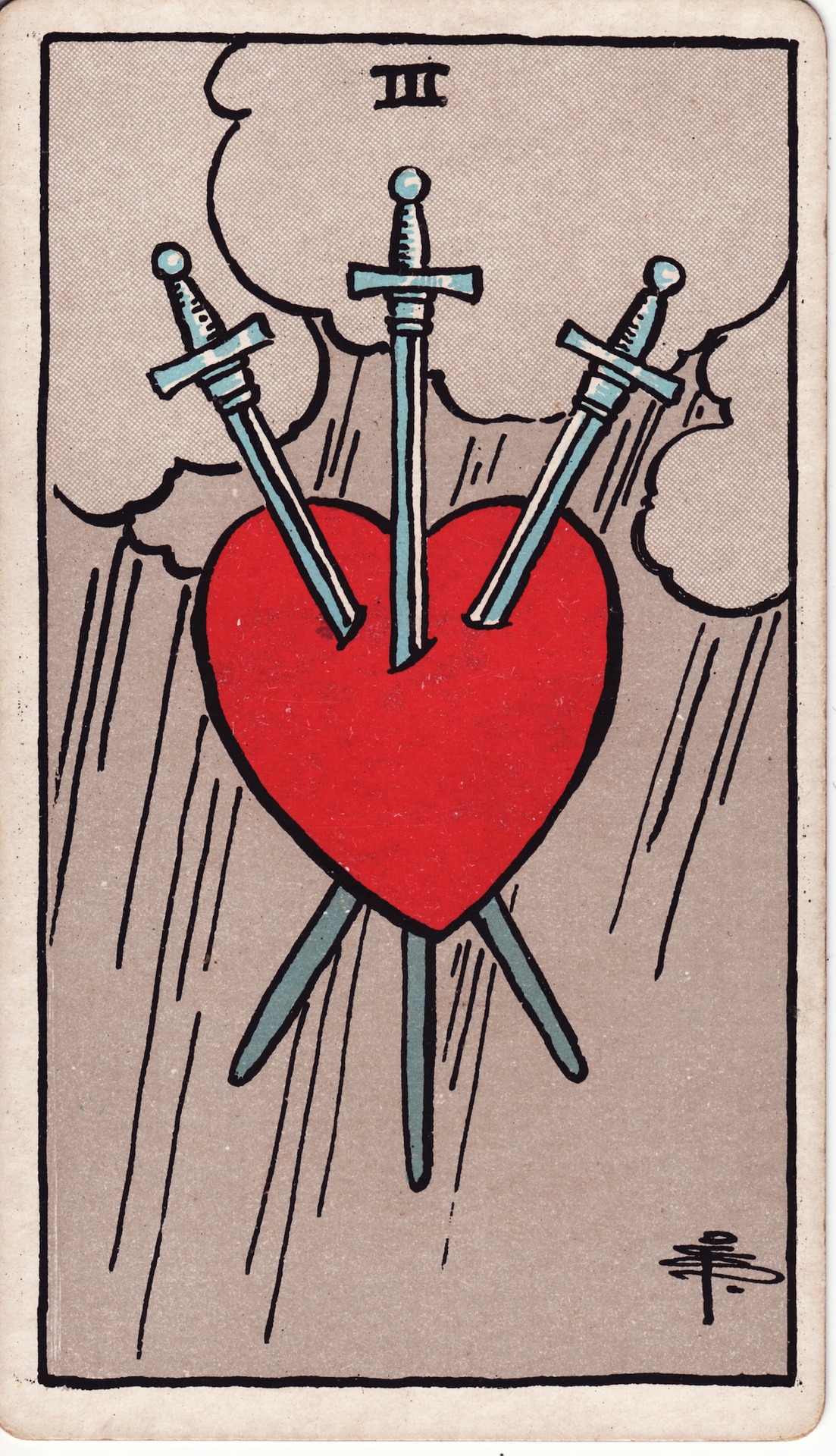
A large red heart hangs against a gray sky, pierced by three swords. The blades enter the heart from above, their points converging inside it and emerging again below. Heavy gray clouds fill the top of the card, and slanting lines of rain fall across the whole scene. There are no people, no landscape, and no horizon; the image is reduced to a single symbol of grief.
It is one of the few minor cards in the deck with no human figure at all. Waite thought the design needed no explanation, describing its meaning as too simple and obvious to call for specific enumeration.1 Threes in the minor arcana often describe a first result or outcome; in the suit of air and conflict, the first result is a wound. One way to read the three blades is as the three ways one person can wound another: by what they say, by what they do, and by what they meant.2 The weather carries a small comfort of its own, since no storm sits over one place forever, and the clouds are as temporary as the ache they stand for.2
Upright
The Three of Swords is heartbreak in its plainest form: sorrow, grief, and the pain of separation. Waite's meanings are removal, absence, delay, division, rupture, and dispersion, and his additional notes give, for a woman, the flight of her lover.1 It often points to the moment the hurt lands: the news is received, the words are said, the truth comes out. Often the blow arrives without warning, and being caught off guard is part of why it cuts so deep.2
In love, it can mean a breakup, a betrayal, a third party coming between two people, or a painful argument that cannot be taken back. It can also be a grief that has nothing to do with romance: a death, an estrangement in the family, a friendship that ends. At work, it may signal rejection, harsh criticism, being let go, or a team split apart by conflict. With money, it can show a loss that hurts more for what it means than for its size.
Sometimes the swords are simply other people's words. A cruel comment online, a bully at the office, or a careless remark from someone close can lodge in the heart and stay there. It helps to treat such words as one person's view, often shaped by their own fears, rather than as a verdict, and to wonder what the speaker might be struggling with. It is also fair to ask why a particular remark stings, since now and then it touches something true that you are not yet ready to look at.2
The card is honest that some things simply hurt. Yet it belongs to swords, the suit of the mind, and the pain here is often tied to a recognition, something now understood that cannot be unknown. The rain in the picture is also a release: crying, shouting, or otherwise letting the feeling out is how it moves through you instead of settling in.2 Letting yourself grieve, rather than numbing it, is how this card eventually passes. The opposite danger is staying in the storm too long, with your attention fixed on the damage instead of on rebuilding.2 Looked back on later, a loss like this is often the thing that taught you something and left you sturdier, and the clarity it brings is part of what lets you move on.2
Reversed
Reversed, the Three of Swords usually describes the aftermath of pain: a period of recovery, forgiveness, and letting go. The wound is still there, but it is beginning to close, and you can talk about what happened without being undone by it. You may also be noticing again the parts of life that never stopped giving you joy.2 In relationships, this can mean reconciliation after a breakup, or simply making peace with an ending.
It can also show grief that has been pushed down rather than worked through. Refusing to feel a loss, insisting you are fine, or keeping an old hurt alive by replaying it all fall under this reading. Useful questions here are what exactly you are mourning, and what the loss might have to teach.2 At work, it can point to lingering resentment after a conflict, or criticism you have not yet been able to hear.
Some readers give the reversal a more inward turn: the swords are now your own thoughts, the steady inner commentary about not measuring up. A simple test is whether you would say those words to a friend; if not, there is little reason to say them to yourself.2 The same card can show oversensitivity to what others say. If someone calls you careless and it stings, check honestly whether there is carelessness to fix, change it if so, and set the rest down.2 In a strained relationship, it asks you to be the one who makes peace: pause before a sharp reply, and apologize readily.2
Waite's reversed meanings are darker and more mental: mental alienation, error, loss, distraction, disorder, and confusion.1 Here the sorrow spreads into the mind, scattering attention and clouding judgment. His additional notes give a meeting with someone the querent has compromised.1 Whichever form appears, the remedy is the same: name the hurt, let it be felt, and give yourself time before making decisions from inside it.
Notes
- A. E. Waite, The Pictorial Key to the Tarot (1911), Three of Swords, https://sacred-texts.com/tarot/pkt/index.htm
- Biddy Tarot, "Three of Swords Tarot Card Meanings", https://www.biddytarot.com/tarot-card-meanings/minor-arcana/suit-of-swords/three-of-swords/