Two (2) of Pentacles
Appearance
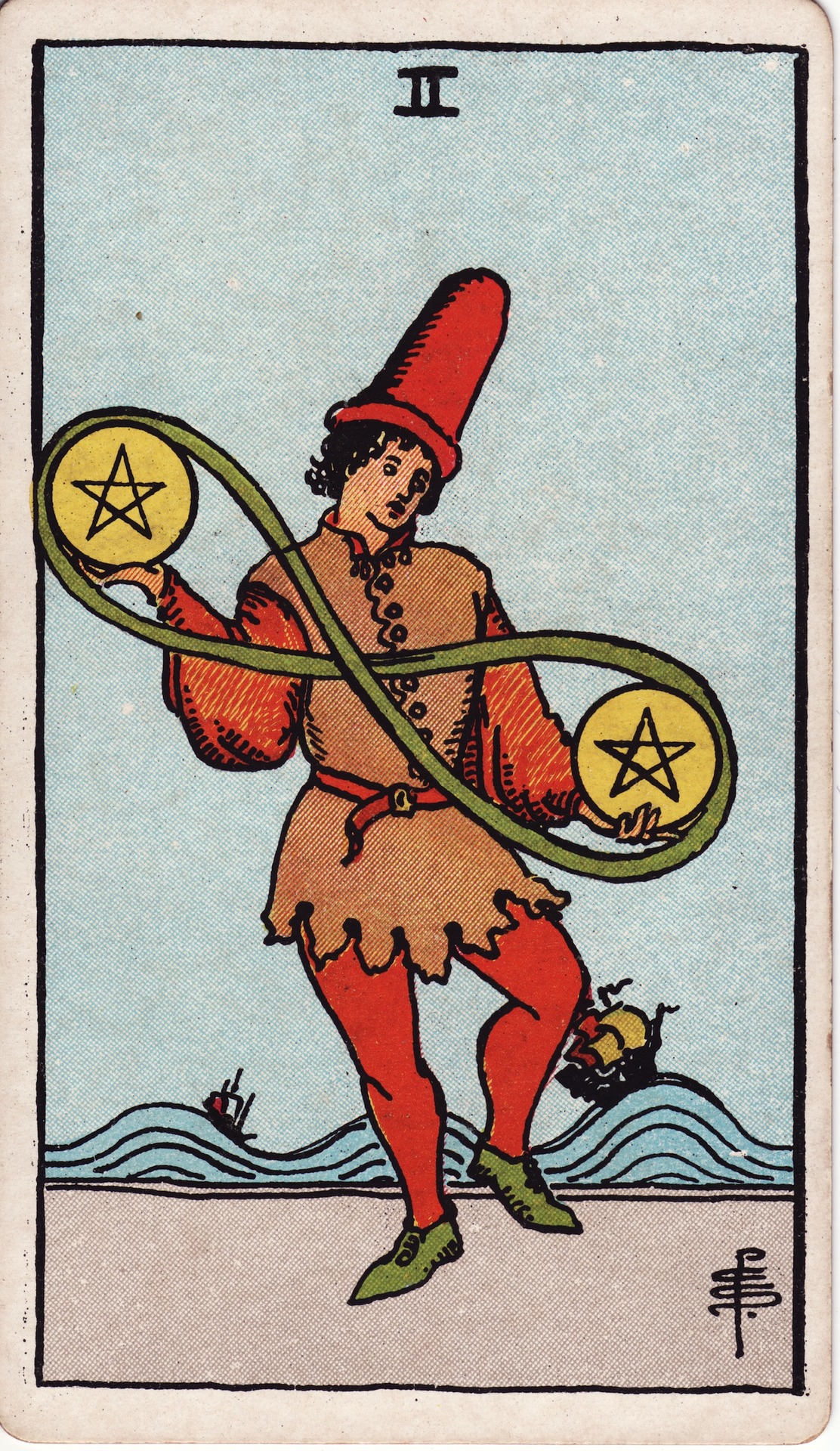
A young man dances on a flat strip of ground, weight shifting onto one foot, with a pentacle held in each hand. A long green cord loops around both coins and crosses in the middle, forming a figure eight laid on its side. He wears a very tall red hat, a brown tunic with a ragged hem, red hose and green shoes, and he watches one coin while the other swings low. Behind him the sea rolls in high waves, and two ships ride up and down the swells, one on either side of him.
Waite described the cord as "like the number 8 reversed," the same endless sign that hovers over the Magician's head.1 Read as infinity, the loop hints that there is no fixed limit to what he can keep aloft, provided he spends his hours and strength wisely.2 The ships repeat his motion on a larger scale: they climb and drop with every wave and still stay afloat, so long as someone is minding the helm.2 Twos are the number of pairs and of choosing between them; in the earthy suit of Pentacles, that becomes the practical work of keeping two things in motion at once.
Upright
The Two of Pentacles is the card of balance kept through movement. Nothing here is settled; two demands compete for the same time, money, or energy, and the trick is to keep both in the air without dropping either. The figure is not frozen by this. He is dancing, and Waite's first reading of the card is gaiety and recreation, a reminder that juggling can be done lightly.1 Upright, the card usually says you are managing it, but it also notes how narrow the margin is between handling everything and having it get away from you.2
With money, it describes managing a budget that has to stretch: paying one bill while waiting on another payment, moving funds around, keeping an eye on cash flow. It can be a sign to prioritize and to stay flexible rather than to make one large move. The dull parts matter here too: due dates, appointments, and the calendar are where a juggler most often slips, and a written list or a stricter routine may do more than willpower. Sometimes the right move is to hand part of the load to someone else.2 At work, it points to multiple jobs, several projects, or a role that pulls in two directions, and to the skill of switching between them. In love, it can mean fitting a relationship around other commitments, or a lighthearted connection that has not yet asked for more.
The card often turns up in a season of constant hurry, going from one task to the next with no pause between. A rest can get more done than another hour of rushing, and a day spent only reacting can hide the question of what all the effort is for.2 It also helps to drop the idea of perfect balance. Home may need most of you this week and work the next, and doing well in one corner of life usually means another is getting less; that shifting is the balancing act, not a failure of it.2
Waite also gives the card news and messages in writing, and less happily obstacles, agitation, and embroilment. An older reading he records is kinder: the troubles are more imaginary than real.1 On the inner level, the card asks you to trust your footing, adapt as the waves shift, and keep a sense of play.
Reversed
Reversed, the juggling stops working. Too many commitments, too little money, or too little time means something is about to be dropped, or already has been. This is the card of being overextended: missed deadlines, bills piling up, a schedule with no slack, and the stress that follows. With money, it warns of disorganization, debt that has grown while you were looking elsewhere, or a cash flow that no longer covers what goes out.
Waite's reversed meaning adds a telling detail: enforced gaiety and simulated enjoyment.1 This is the person who keeps smiling and saying everything is fine while the coins wobble, and who may be the only one who knows how close things are to slipping.2 In love, it can mean a relationship squeezed out by work or other obligations, or a partner who is present in body but stretched too thin to really show up.
The reversal can also mean the opposite of scattering: too much weight on a single coin. A career that is going very well can be quietly costing a marriage or a family, and the late nights that seemed harmless at first eventually add up to a bill someone else pays.2
Waite also lists letters, handwriting, and letters of exchange, so the card can point literally to paperwork, contracts, or bills that need attention.1 The remedy is usually to put one coin down: say no to something, renegotiate a commitment, or ask for help before balance turns into collapse. A budget and a plan for the coming weeks help, and so does declining offers that no longer fit where you are trying to go. If everything feels urgent, pick the one thing that matters most and give it your full attention for a while.2
Notes
- A. E. Waite, The Pictorial Key to the Tarot (1911), Two of Pentacles, https://sacred-texts.com/tarot/pkt/index.htm
- Biddy Tarot, "Two of Pentacles Tarot Card Meanings", https://www.biddytarot.com/tarot-card-meanings/minor-arcana/suit-of-pentacles/two-of-pentacles/