Wheel of Fortune (X)
Appearance
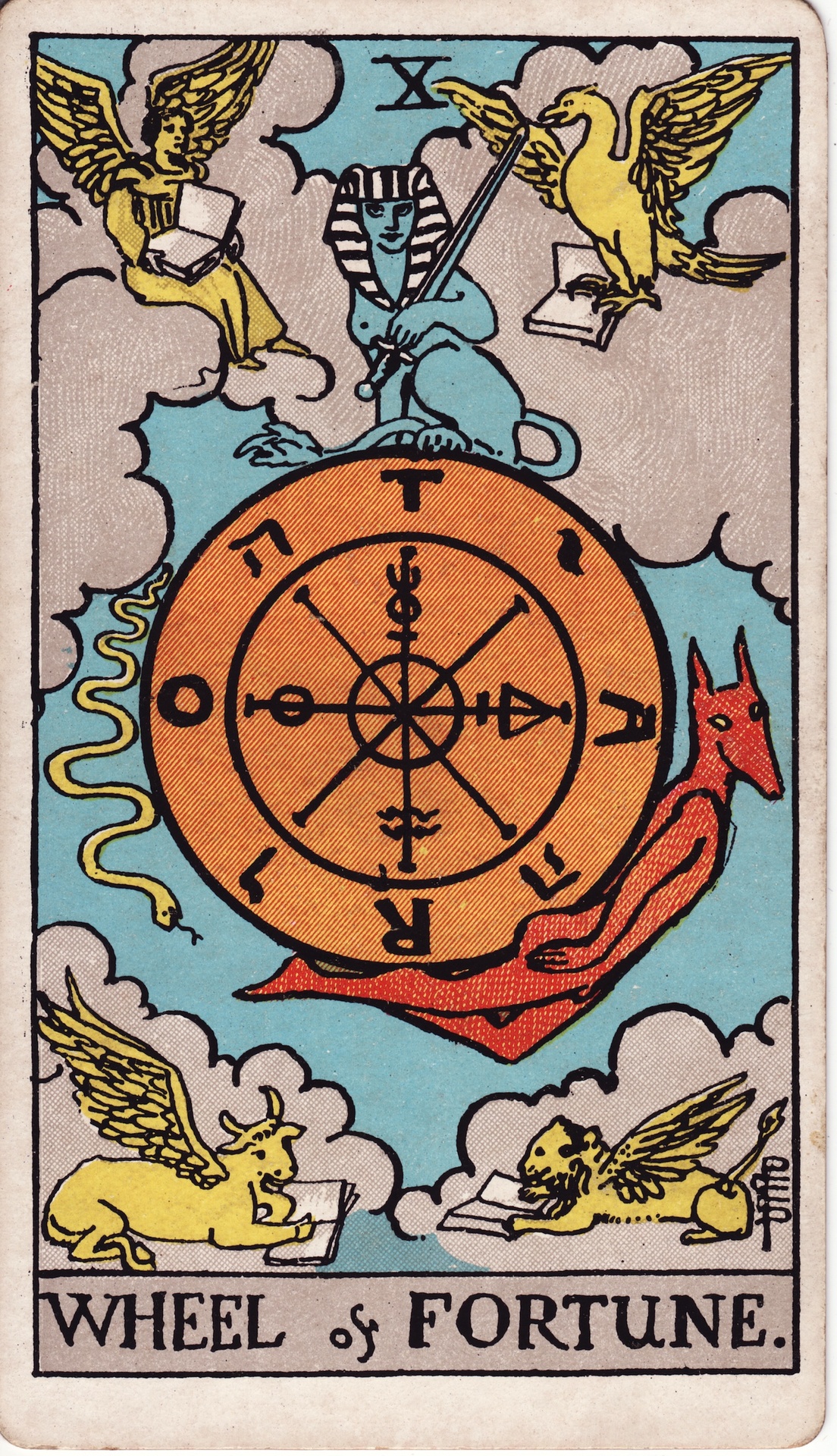
An orange wheel floats among clouds. On its outer rim the letters T, A, R, O alternate with the four Hebrew letters of the divine name, and its inner spokes carry the alchemical signs for mercury, sulfur, salt and water, the stuff of all matter.1 A blue sphinx with a sword sits on top. A yellow serpent slides down the left side, and a red jackal-headed figure is carried up the right. In the corners, winged creatures rest on clouds with open books: an angel, an eagle, a bull and a lion.
Waite took the design largely from Eliphas Levi.2 He named the serpent as Typhon, called the sphinx the point of balance within the movement, and identified the corner figures as the four living creatures of Ezekiel's vision.2 They also match the four fixed zodiac signs, and their wings keep them steady while all between them spins.1 The descending serpent suggests an old skin shed, and the rising figure is Anubis, guide of the dead, so loss and renewal share one rim.1 The letters read as ROTA, Latin for wheel, as TARO, or as TORA, the law.1 Waite read the card as a denial of mere chance.2
Upright
The Wheel of Fortune is the card of turning points, cycles and luck. Circumstances are moving, often in ways no one controls, and the card usually marks a change for the better: a lucky break, an opportunity that arrives at the right time, a situation that suddenly opens up. Waite's meanings are destiny, fortune, success, elevation, luck and felicity.2 Behind them lies the old image of Fortune's wheel, which lifts some people up and brings others down, and the reminder that no position on it is permanent. That cuts both ways: a hard stretch will lift, but a good one will not last forever either, so enjoy it fully while it is here.1
At work, the Wheel can point to a promotion, a new opening, or being in the right place when something shifts. With money, it favors gains and good timing, though not guarantees. In love, it can mean a meeting that feels fated, a relationship moving to a new stage, or the return of someone from the past. For someone in a difficult period, it often signals that the cycle is turning. Sometimes the opening is bigger than expected, a chance to change direction entirely, and it pays to take it seriously even if it looks unfamiliar.1
Many readers also treat the Wheel as a card of karma: what you put out tends to come back to you, so kindness and generosity now are part of how the turn goes.1 It asks for some optimism and attention to coincidences and timely signs, and for willingness to accept help, whether from people around you or from whatever you count as spiritual support.1 For anyone who likes to keep things under control, the card can be unsettling, since it says outside forces are steering and pushing back will not stop them.1
On a personal level, the card asks you to recognize patterns: the lessons and situations that come around again until they are understood. The sphinx sits calmly at the top while the wheel spins beneath it, which suggests that the best response to change is balance, adapting to what moves while holding on to what does not.
Reversed
Reversed, the Wheel of Fortune often describes a downturn or a run of bad luck: plans disrupted by events outside your control, delays, setbacks, and the sense that the world has turned against you. At work, a change you did not choose may arrive, such as a restructuring, a lost contract, or a shift in the market. With money, it is a time for caution, not gambling.
Even here there is a choice between waiting for the luck to change and acting to change it. The useful first step is honest accounting: what part did your own earlier decisions play in getting here, and what would you do differently next time? Owning that much is what turns a bad turn into something you can steer out of.1
It can also mean resisting change that is already underway, trying to hold the wheel still because the current position feels safer than the unknown. In relationships, this may show up as clinging to an old pattern, repeating the same argument, or refusing to accept that something has entered a new phase. The strain usually comes less from the change than from the fight against it.1
There is a hopeful reading too: the reversal can mark the moment a bad cycle finally breaks, once you see how your own habits kept it going. Some people get there through quiet reflection; others only after things collapse, a path more likely when the Devil or the Tower is nearby.1
Waite's reversed meanings run the other way entirely: increase, abundance, superfluity.2 In this reading the wheel is still turning in your favor, but toward excess, and too much of a good thing can create its own instability. Either way, every phase passes, so prepare during the good times and endure the hard ones.
Notes
- Biddy Tarot, "Wheel of Fortune Tarot Card Meanings", https://www.biddytarot.com/tarot-card-meanings/major-arcana/wheel-of-fortune/
- A. E. Waite, The Pictorial Key to the Tarot (1911), Wheel of Fortune, https://sacred-texts.com/tarot/pkt/index.htm