Eight (8) of Cups
Appearance
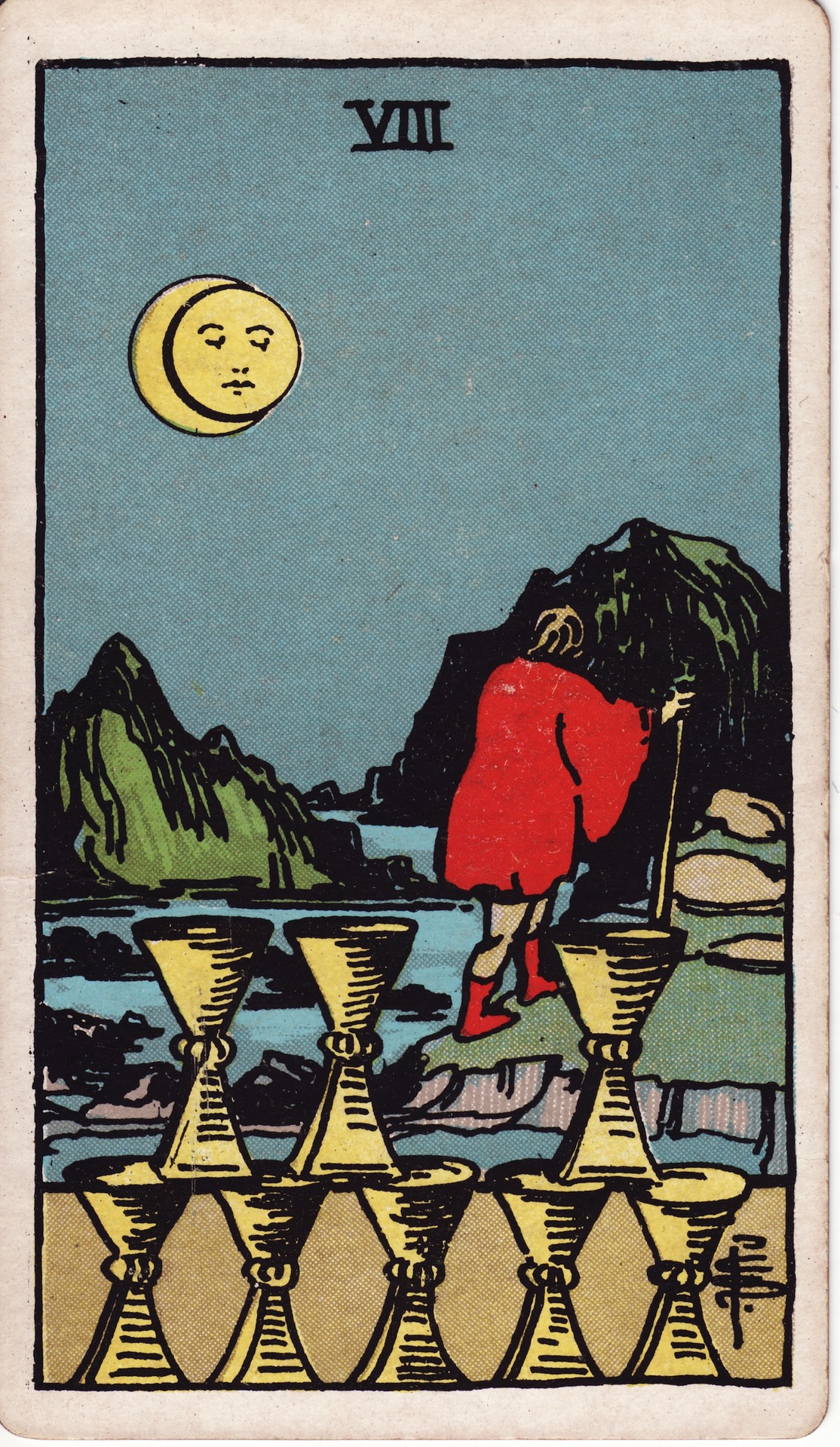
Under a dim evening sky, a man in a red cloak and red boots walks away from the viewer, leaning on a staff as he climbs toward rocky hills. In the foreground stand eight golden cups, five on the bottom row and three stacked above them, with a visible gap in the upper row where another might have been. That gap is the point of the picture: the set is incomplete, and what is missing is the sense of being whole.1 Between the cups and the hills lies water and marshy shore, the feelings he has to cross, and the hills ahead promise a hard climb that is still worth making.1 Above, the moon shows a sleeping face inside a crescent, as if it were full and waning at once, or in eclipse.
Eight is a number of movement after consolidation, and in this suit it means leaving an emotional investment behind. Waite described a man "of dejected aspect" deserting "the cups of his felicity, enterprise, undertaking or previous concern."2 The figure also leaves by night, when no one is watching, which hints that part of this departure may be a quiet escape rather than an open farewell.1
Upright
The Eight of Cups is the card of walking away. Something that once mattered, a relationship, a job, a home, a creative project, no longer satisfies, and you choose to leave it behind to look for something deeper. The cups are not broken or spilled; they are simply not enough. That is what makes the card hard: there is no obvious disaster to justify going, only the sense that staying would mean settling. From outside it may look as though you already have everything you wanted, so friends may not understand why you are leaving, and the leaving can carry real grief even when it is right.1
In love, it can mean ending a relationship that is comfortable but empty, or withdrawing emotionally from one that has stopped growing. At work, it points to leaving a secure position for something more meaningful, abandoning a project you have outgrown, or a career change driven by values rather than money. Financially, it may mean accepting less security for a time.
There is a shadow side to the card. The cups stay where they were left, and walking away from them does not make them disappear. Sometimes the Eight shows avoidance: refusing to talk about what is wrong, pushing feelings down, acting as if all is well, or simply not showing up.1 It is worth asking honestly whether you are moving toward something or only away from a problem you would rather not face.
Waite noted that in practice the card often shows "the decline of a matter," or that something thought important turns out to be "of slight consequence."2 He also recorded readings that run the other way entirely, among them joy, mildness, timidity, honor and modesty.2
Inwardly, the Eight of Cups is the beginning of a search. The figure climbs into the hills alone and at night, guided by moonlight rather than certainty. If you find yourself making this same exit again and again, the search may need to start with the goal itself: perhaps what you were after was never a partner as such but a deep bond with one, and no amount of time in the wrong arrangement will supply it.1 Work out what actually feeds you and set your aims by that. It takes courage to leave what you know for what you only sense.
Reversed
Reversed, the departure stalls or turns back. You may know something has run its course but cannot bring yourself to go: staying in a relationship from fear of being alone, remaining in a job because the alternative seems too uncertain, or drifting between leaving and returning. The useful question is whether the situation can still get better or is truly finished, and that is something your own intuition can answer better than the opinions of people around you.1 Neighboring cards can tip the balance: next to quiet, waiting cards like the Four of Swords or the Hanged Man, it leans toward one more attempt, while beside fast-moving cards like the Chariot or the Eight of Wands, it leans toward leaving.1
The reversed card can also show the opposite mistake: walking away too readily, abandoning things whenever they get difficult, or running from feelings instead of facing them. A related pattern is restlessness, moving from place to place or partner to partner because nothing ever feels like enough, always sure the next thing will be better. The remedy is to name what genuinely contents you and build toward it.1
Waite's own reversed meaning goes in a different direction altogether: "great joy, happiness, feasting." His later notes add "perfect satisfaction."2 Read this way, the reversal can mean the search is over, a decision to stay that is genuinely right, or contentment found in what is already there.
In love, it can point to recommitting after a period of doubt, or to the return of someone who had pulled away. At work, it may mean reconsidering a planned exit, or finding new meaning in the familiar. The question is whether you are staying or going out of fear, or from a clear sense of what you need.
Notes
- Biddy Tarot, "Eight of Cups Tarot Card Meanings", https://www.biddytarot.com/tarot-card-meanings/minor-arcana/suit-of-cups/eight-of-cups/
- A. E. Waite, The Pictorial Key to the Tarot (1911), Eight of Cups, https://sacred-texts.com/tarot/pkt/index.htm