Nine (9) of Cups
Appearance
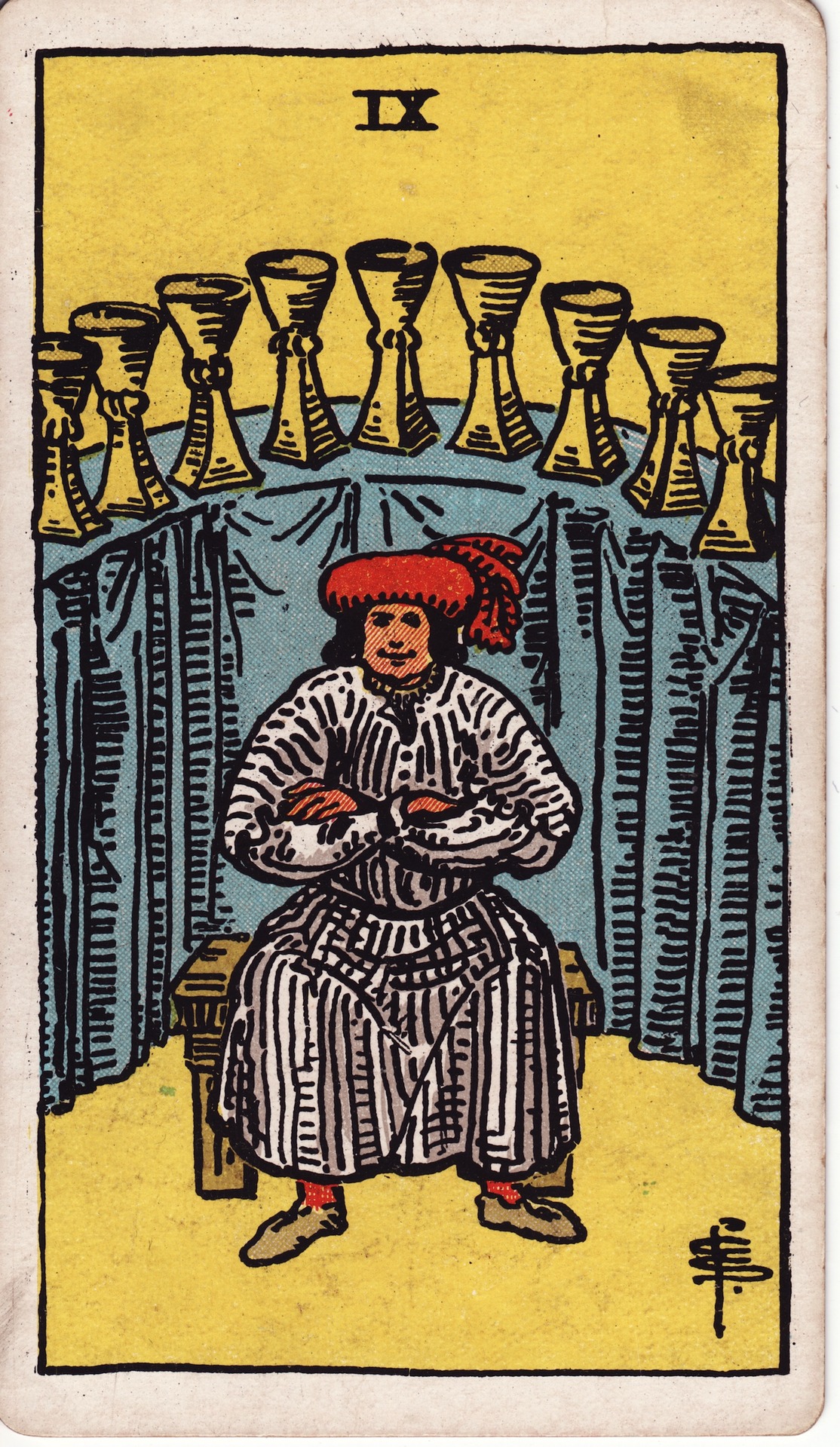
A stout, well-fed man sits on a plain wooden bench with his arms folded across his chest and a satisfied smile on his face. He wears a red cap and a long white robe. Behind him, a curved counter draped in blue cloth holds nine golden cups in an arch, like trophies on display. The background is a warm, flat yellow, and there is nothing else in the scene: no other people, no landscape, only the man and his cups.
Nine is the near-completion of the suit, and in cups it is the fulfillment of desire. Waite described the figure as one who "has feasted to his heart's content," with enough wine laid by to suggest that the future is assured as well.1 The arch of cups can be read as the feelings that come once a deep wish has been acted on and seen through.2 The seat matters too: a bare plank is pleasant for a while but no one would choose to stay on it all day, a quiet hint that this kind of ease does not last forever.2 Popularly it is known as the wish card.
Upright
The Nine of Cups is the card of satisfaction, contentment, and wishes fulfilled. What you hoped for has come, or is about to, and you are allowed to enjoy it. Waite's meanings are concord, contentment, physical well-being, victory, success and advantage.1 Many readers treat it as the wish card: when it appears in answer to a question, the answer tends to be yes, and if you are still waiting on something you asked for, it is a strong sign that the wait is nearly over.2 The contentment is often broad rather than narrow, a moment of looking around at home, work, health and friends and finding that all of it is good at once.2
In love, it can describe a relationship that is happy and secure, or for a single person the pleasure of a full life on your own terms, with romance a likely addition rather than a missing piece. At work, it points to recognition, a goal reached, a project that turned out as planned, or the comfort of being good at what you do. With money it is strongly favorable: a comfortable surplus, a gain, enough to indulge a little.
Waite noted that the picture shows "the material side only, but there are other aspects."1 The card's pleasures are real, but they lean toward food, comfort, possessions and status. It gives permission to treat yourself for a time: a good meal and a bottle of wine, a concert or gallery, a night with a lover, a few days somewhere luxurious, without worrying in advance about the cost.2 It also asks you to notice what you have and say thanks for it. One simple habit is to name a few things you are grateful for at the start or end of each day; some readers hold that this practice both deepens contentment and draws more good things in.2 And since the bench will not stay comfortable, the moment is worth savoring now, before circumstances shift and you have to adjust.2 Contentment also tends to last longer when it is shared.
Reversed
Reversed, the satisfaction falls short. A wish may come true and feel hollow, or it may not come at all. The card can describe smugness, overindulgence and materialism: eating, drinking or spending past the point of enjoyment, or measuring happiness by possessions. A common picture is the person with the biggest house on the street who rarely sees the people they love; the wishes were chosen to impress others, and the ego got what it wanted while the heart did not.2 In relationships, it can show complacency, taking a partner for granted, or expectations so high that nothing real can meet them.
Waite gives an unexpected set of reversed meanings: "truth, loyalty, liberty," though he adds that "the readings vary and include mistakes, imperfections."1 His later notes add good business.1 One way to hold these together is to see the reversal as a turn from outer satisfaction to inner values, where the cups on display matter less than honesty and freedom. Some readers make this the heart of the reversed card: happiness has to be found inside, and if the outer markers of success are not satisfying, the fix is to decide for yourself what success would actually look like.2
The reversal can also mean impatience with a wish that has not yet arrived. The hope could be out of reach, or perhaps you are waiting for it to happen without doing much to bring it about. Goals that no longer mean anything to you can be dropped; the ones that remain may need reshaping to fit your values and a concrete plan to move them forward.2
At work, the blocked form shows a goal reached that does not deliver what was promised, or success that breeds arrogance. With money, it warns of overspending to keep up appearances. With health, it is a caution against excess in food, drink, drugs or late nights, trading tomorrow's well-being for tonight's pleasure; moderation is the advice.2 Inwardly, ask what you really wanted from the wish. Sometimes the answer is not more cups but a different kind of contentment.
Notes
- A. E. Waite, The Pictorial Key to the Tarot (1911), Nine of Cups, https://sacred-texts.com/tarot/pkt/index.htm
- Biddy Tarot, "Nine of Cups Tarot Card Meanings", https://www.biddytarot.com/tarot-card-meanings/minor-arcana/suit-of-cups/nine-of-cups/