King of Cups
Appearance
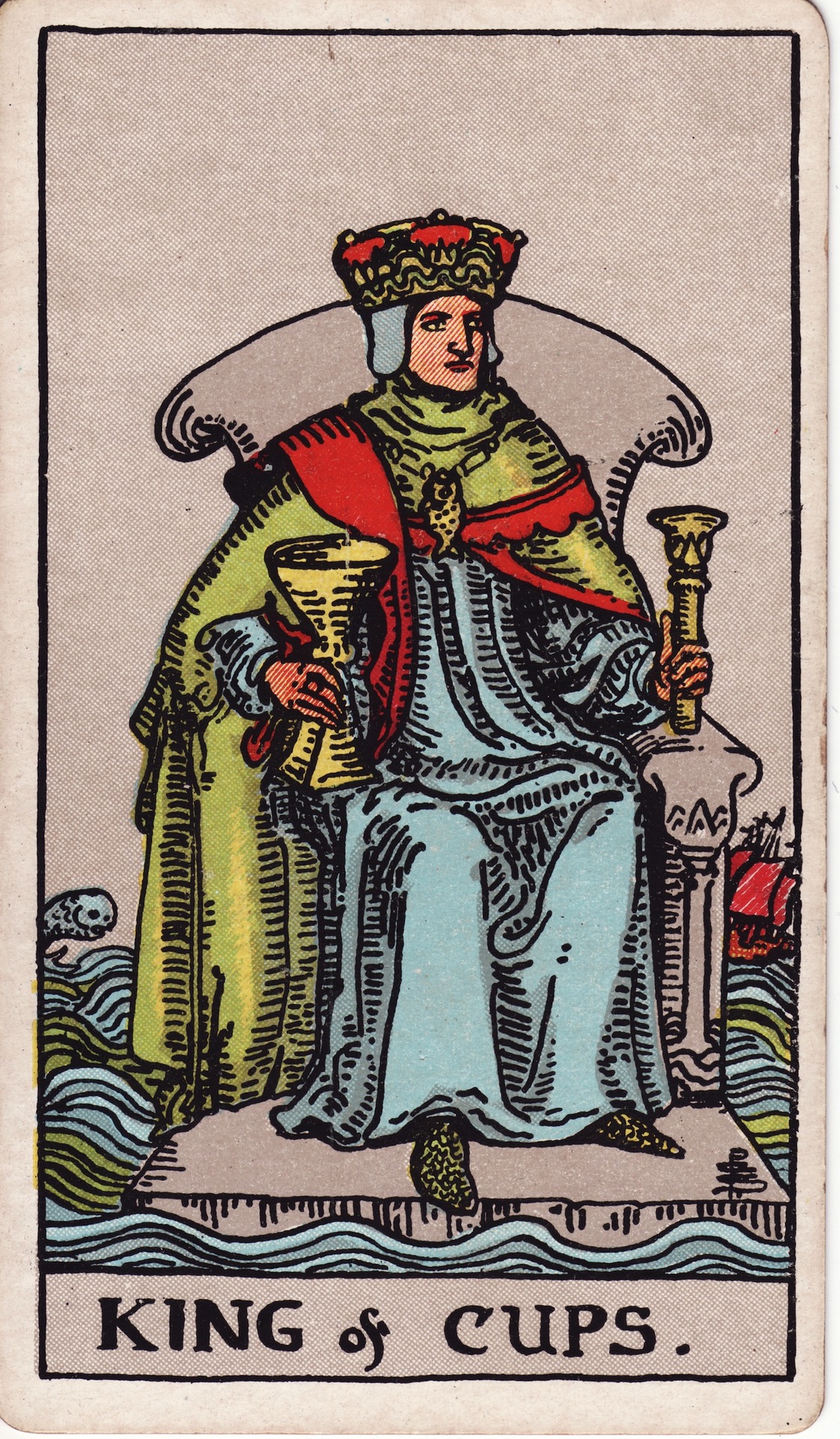
A king sits on a square stone throne that floats on the open sea, with waves rolling around its base. He holds a golden cup in his right hand and a short scepter in his left. He wears a crown, a pale blue robe, and a yellow-green cloak with a red collar, and a fish-shaped pendant hangs at his neck. To one side a fish leaps from the water; on the other a ship with red sails rides the waves. His expression is calm and steady.
Kings stand for mastery of their suit, and the King of Cups has mastery over the realm of feeling: he sits among the waves without being moved by them. Waite noted that water "appears in all the court cards" of this suit, and named the leaping fish a dolphin.1 The fish is the impulse rising from below and the ship is the course held anyway: he stays open to what surfaces without being swamped. The pendant hints at his creative side. Unlike the other court figures of the suit, he does not gaze into his cup, as if knowing his own heart no longer needs his full attention.2
Upright
The King of Cups is the card of emotional maturity, calm, and compassionate authority. He feels as deeply as anyone in the suit, but he is not ruled by his feelings; he can hold steady while the sea moves around him. His command reaches past emotion into creativity and the unconscious.2 He leads with diplomacy, patience, and a balance of heart and head. When things go wrong without warning, he does not get pulled into the drama; he chooses the level response.
As a person, he is wise, generous, and trustworthy: the mentor, the counselor, the steady parent, the doctor or lawyer or teacher who is both competent and kind. Waite described a fair man of business, law, or divinity, "responsible, disposed to oblige the Querent," and connected him with equity, art and science, and "creative intelligence."1 He is someone you can bring a problem to and leave feeling calmer. He takes in the whole web of people in a room, and he may show up as a coach or spiritual guide, or the card may be asking you to become that figure for someone else.2
When other people bring hostility or heavy moods, the king's answer is to stay grown-up about it: say plainly what you will and will not accept, and do not let anyone talk you out of your own values or your own read on what you feel.2
In love, the card points to a mature, caring partner, a relationship built on emotional security, or the ability to stay level during conflict, sometimes by easing a partner past their sore spots so the peace holds.2 At work, it favors leadership through understanding rather than control, the kind that cares as much about whether the team is engaged as about hitting the target, and success in professions that combine skill with care: medicine, law, counseling, the arts.2 With money, it suggests sound judgment and generosity without recklessness.
Inwardly, the king asks you to master your emotions without suppressing them, keeping a calm center that lets you respond rather than react. If you notice logic and feeling drifting apart in yourself, he is the figure to call to mind to bring them back into line.2
Reversed
Reversed, the king's composure fails or turns false. Emotions may be held down so tightly that they burst out as anger or coldness, often because facing them directly feels too frightening, or he may drift into moodiness, self-pity, or escape through drink and distraction.2 You may find yourself easily set off, anxious, or hard on yourself over small mistakes, short on the compassion you would give anyone else.2
There is a quieter reading as well: the reversal can show attention turned inward, to the feelings stored below the surface and how they steer you. Journaling, reading, or work with a counselor can help you trace a mood back to where it starts, so it stops quietly running the show.2 Others may provoke you, but keeping your balance remains your job.2
Waite's reversed meanings are severe: a "dishonest, double-dealing man," with roguery, exaction, injustice, vice, scandal, pillage and "considerable loss."1 Even his later notes on the upright card warn of ill will from a man of position and of hypocrisy pretending to help, and they give the reversal as simply loss.1
As a person, the reversed king can be a charming authority figure who cannot be trusted, an emotionally distant partner, or someone whose calm hides volatility. At his worst he is vindictive, wielding guilt and emotional pressure to get what he wants, until you come away sure that you are the one at fault. If you recognize someone like that from your past, there may still be work to do in getting free of his hold.2 In love, he may show withdrawal, or a partner who withholds feeling as a form of control. At work, be wary of a leader whose kindness has strings attached, or of your own habit of bottling up stress. With money, the reversal warns of loss through bad faith or poor judgment. The advice is to let feelings be felt and expressed honestly.
Notes
- A. E. Waite, The Pictorial Key to the Tarot (1911), King of Cups, https://sacred-texts.com/tarot/pkt/index.htm
- Biddy Tarot, "King of Cups Tarot Card Meanings", https://www.biddytarot.com/tarot-card-meanings/minor-arcana/suit-of-cups/king-of-cups/