Queen of Cups
Appearance
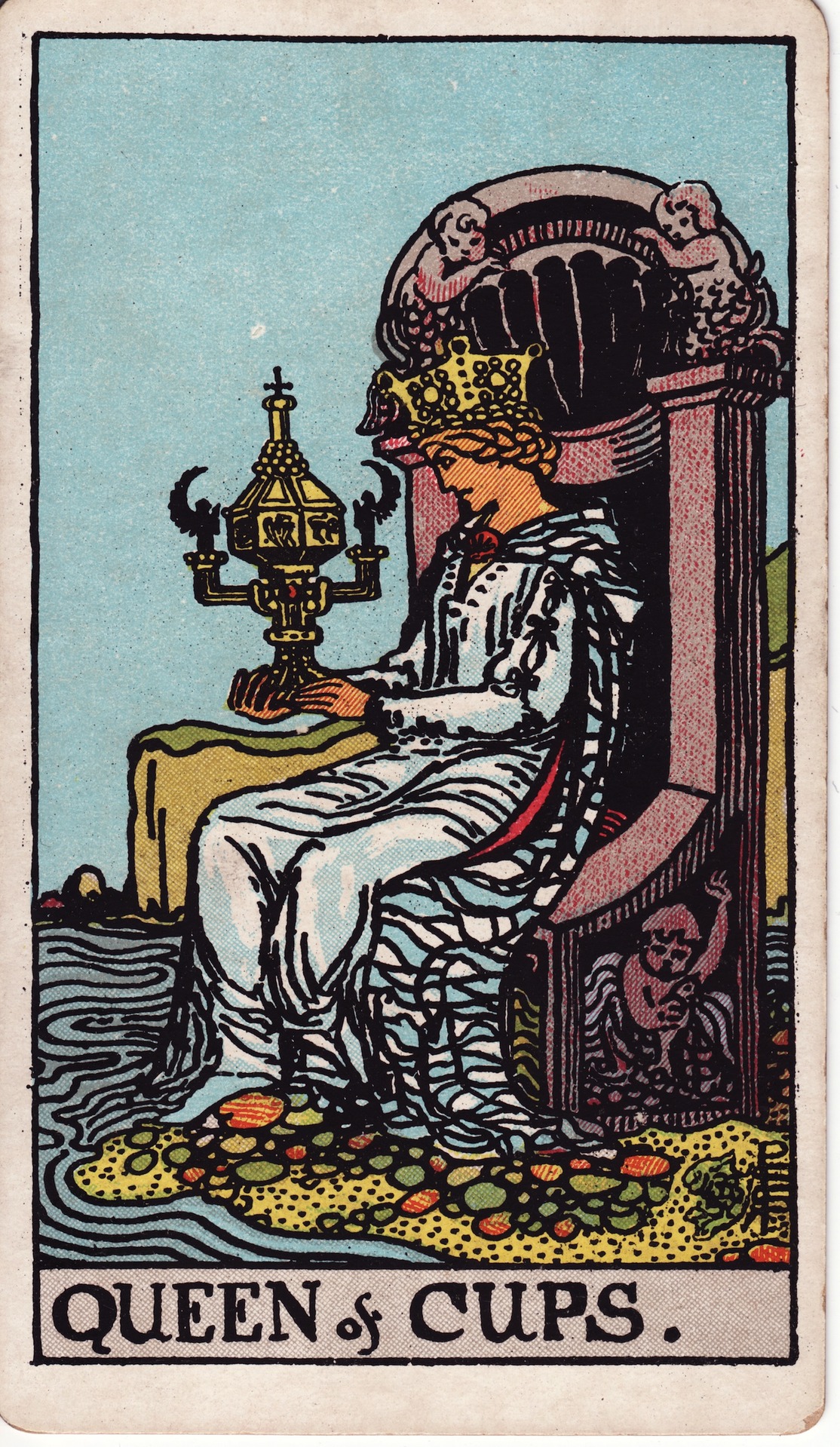
A crowned queen in a white and pale blue gown sits on a carved stone throne beside the sea, her feet resting on a shore of colored pebbles where the water laps in, and the folds of her robe seem to run into the waves. She holds a large, ornate covered cup and gazes into it intently. Unlike the other cups of the suit, hers is closed, with handles shaped like winged angels and a small cross on the lid. The back of her throne is shaped like a shell, and it is carved with small figures of sea children.
Queens hold the inward, receptive side of their suit, and in cups this means emotional depth and intuition. Waite described her as "dreamy, as one who sees visions in a cup," but added that "she sees, but she also acts, and her activity feeds her dream."1 The lid suggests that what she knows comes from somewhere private, below ordinary thought, and the sea belongs to that same hidden realm.2 She sits at the waterline, yet her feet stay on dry stones: she is in contact with feeling without going under.2
Upright
The Queen of Cups is the card of compassion, intuition, and emotional wisdom. She feels deeply but is not overwhelmed by feeling; she holds it, the way she holds her closed cup, and draws insight from it. Waite's meanings are "loving intelligence, and hence the gift of vision," together with success, happiness, pleasure, wisdom and virtue.1
As a person, she is warm, perceptive, and trustworthy, someone others turn to in a crisis because she listens without judgment. Waite described a good and honest woman devoted to the querent and, in the language of his time, "a perfect spouse and a good mother."1 She can be a counselor, a nurse, an artist, a parent, or anyone of any gender who leads with empathy. Her particular skill is letting someone pour out what they feel without soaking it up herself; she is settled enough to know where her own feelings end and theirs begin.2 She also reads people quickly and adjusts how she speaks, so that the other person comes away feeling understood.2
In love, the card favors deep emotional connection, a partner who is attentive and caring, and a relationship where feelings can be spoken safely. At work, it suits the healing and caring professions, creative work, and leadership grounded in emotional intelligence. Creative projects go best when she follows her sense of what feels right rather than a fixed plan, and she takes seriously the quiet signal that something is wrong even before she can explain it.2 With money, she cares more about what money does for people than about money itself.
Inwardly, the queen asks you to trust your intuition, to care for yourself as carefully as you care for others, and to let your feelings inform your actions rather than rule them. Guidance may arrive sideways, through dreams, meditation, or attention to the rhythms of the moon and the seasons, and it is worth making room for.2 The card also asks you to let hard feelings be felt in full instead of hurrying past them.2
Reversed
Reversed, the queen's sensitivity loses its balance. Emotions may flood in until judgment is swamped, or turn inward until they become moodiness and self-pity. She may give so much to others that nothing is left for herself, or depend on others for a security she cannot supply alone. Martyrdom, codependency and burnout belong to this form. Sometimes the caretaking is itself the trouble: being needed feels good, and help offered too freely can keep the other person leaning on her.2
The opposite failure is just as likely. Feelings may be pushed down and kept out of sight until they come back as stress, or boil over all at once.2 Either way, the remedy is time alone with them: a journal, a few cards, a quiet hour, and an honest question about what you actually feel, pleasant or not.2 Intuition is often loud in this reversal, but a crowded schedule drowns it out.2 Where feelings are overwhelming, let them out somewhere safe, on paper or with a therapist, and then look at why they surfaced now.2
Waite admitted that "the accounts vary." In some, the reversed queen is still a good woman; in others she is distinguished "but one not to be trusted," or perverse, with vice and dishonor attached. His later notes say the card sometimes denotes a woman of equivocal character, and give the reversal as a rich marriage for a man and a distinguished one for a woman.1
As a person, the reversed queen can be someone emotionally manipulative, needy, or unpredictable. In love, she points to insecurity, jealousy, or a relationship where one partner carries all the emotional weight. At work, a caring role may be sliding into exhaustion, or decisions may be made from mood rather than sense. The advice is to set boundaries and tend your own cup first. Other people's feelings are theirs to work through; you can stay present for someone without taking over their job of coping.2
Notes
- A. E. Waite, The Pictorial Key to the Tarot (1911), Queen of Cups, https://sacred-texts.com/tarot/pkt/index.htm
- Biddy Tarot, "Queen of Cups Tarot Card Meanings", https://www.biddytarot.com/tarot-card-meanings/minor-arcana/suit-of-cups/queen-of-cups/