Knight of Cups
Appearance
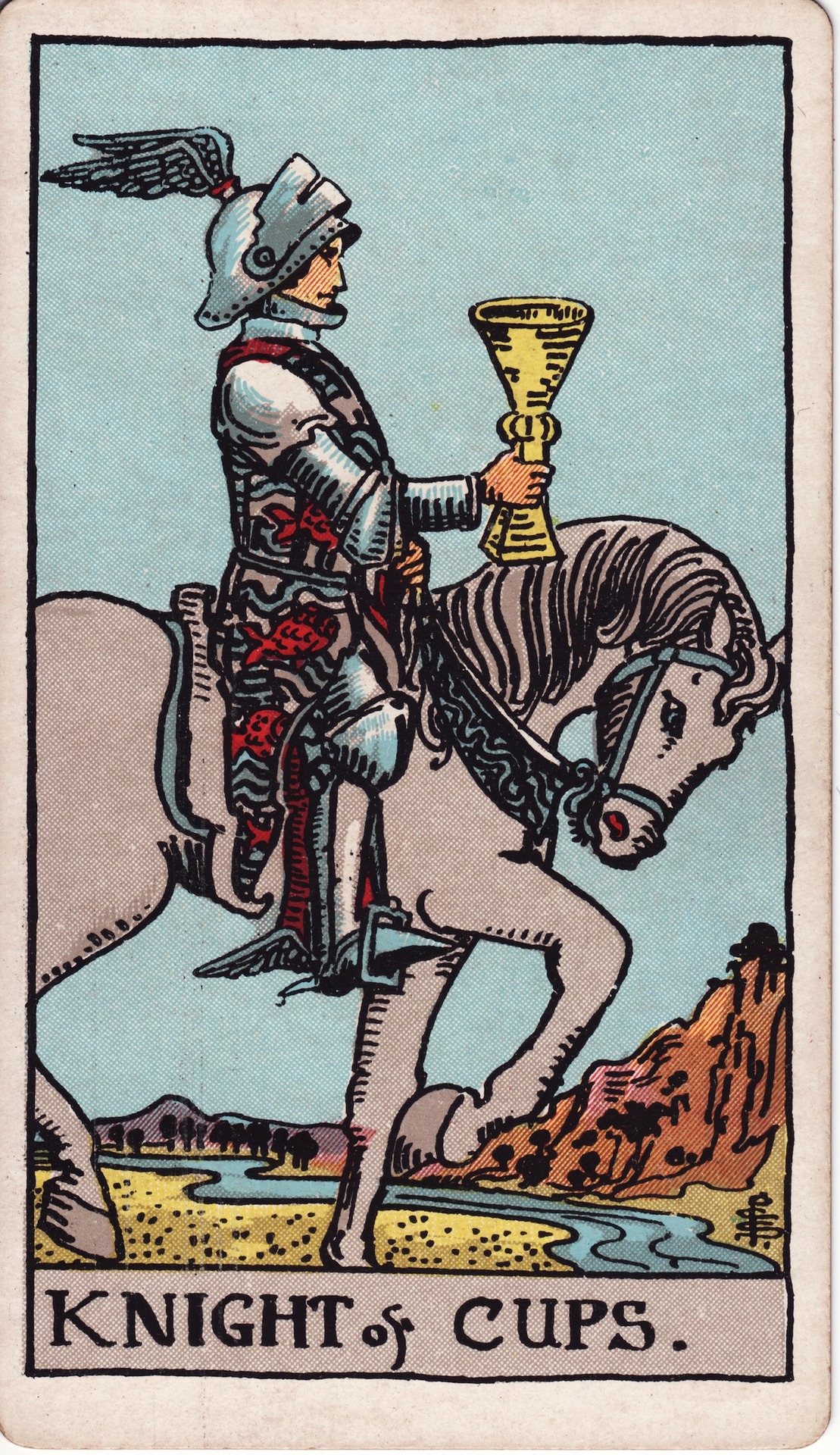
A knight in silver armor rides a pale gray horse at a slow walk, holding a golden cup out before him as if presenting it. His helmet and his heels are winged, like those of Hermes, and the tunic over his armor is patterned with red fish. The horse steps forward with its head lowered, calm and unhurried. Ahead lies a winding stream, and beyond it a reddish crag and low hills with trees.
Knights are the movement of their suit, and this one carries water rather than fire: he is the romantic and the messenger, not the warrior. Waite described him as "graceful, but not warlike," and read the winged helmet as a sign of "those higher graces of the imagination." He too, Waite says, is a dreamer.1 The Knights of Wands and Swords charge; his horse walks, and the scene takes its calm from that pace.2 The fish stand for the suit's water, for feeling and the creative life, and the wings suggest a quick imagination and a love of beauty.2 The country around him is mostly bare, yet the stream runs through it, a hint that feeling and imagination can bring life to ground that looks dry.2
Upright
The Knight of Cups is the card of romance, invitations, and following the heart. Something is approaching: an offer, a proposal, a messenger bringing good news. Waite's meanings are arrival and approach, "sometimes that of a messenger," along with advances, propositions, invitations and incitement. His later notes add a visit from a friend who brings unexpected money.1
As a person, the knight is charming, idealistic, and emotionally expressive, the romantic who leads with feeling. He may be an artist, a poet, a diplomat, someone who prefers persuasion to force. At his best he is sincere and generous; he acts on his ideals, though at the pace of a slow walk rather than a charge. His kindness toward others grows out of having come to terms with his own moods, and he gives affection openly, without much calculation; what he loves most may be the state of being in love.2 Every knight rides on some errand, and his is a gentle one: kindness, beauty, and a hope that everyone involved comes out of it at peace.2
In love, this is the classic card of a suitor: a declaration, a date, a proposal, or simply being swept up in courtship. At work, it favors creative projects, offers that appeal to your values, and roles where diplomacy or imagination count. It can bring a job offer or an invitation to collaborate. With money, it may mean an unexpected gift or payment.
Inwardly, the knight asks you to follow your heart and act on what you feel, while remembering that inspiration has to be carried somewhere, not just admired. The Page of Cups is the moment an idea first surfaces; the Knight is the stage where you start working on it, and a hobby or private passion may be ready to become a real piece of work.2 When this card appears, decisions tend to be made by feel rather than by reasoning, and that can be right even when the people around you cannot follow your logic.2
Reversed
Reversed, the knight's charm turns unreliable. Waite's reversed meanings are pointed: "trickery, artifice, subtlety, swindling, duplicity, fraud."1 As a person, he may be a charmer whose promises evaporate, someone who woos with words but does not follow through, or a manipulator who uses feeling to get his way. Waite's later notes add a simpler word: irregularity.1
In love, the reversal warns of unrealistic romance, being swept off your feet by someone who is not what they seem, or a proposal that comes with hidden conditions. It can also show moodiness and jealousy, or a person so caught up in their own feelings that they cannot see anyone else's. At work, be wary of offers that look generous but do not hold up, and of creative projects that never move past the idea stage. With money, read the fine print.
The reversal can also describe a romantic outlook that has drifted away from practical life. Carried along by the feeling of a moment, you may say yes to something and then find it is not what you pictured: the move to a pretty small town that turns out to be lonely in winter, or the dream job whose daily routine is dull.2
The blocked form is a heart that cannot act: feelings left unspoken, invitations delayed or canceled, or an artist stalled by perfectionism. Often a project is taking shape but you are not ready to begin it, and the hours go into picturing how good it will be once it is done.2 Some time in that dreaming stage is healthy, but the idea becomes real only when you pin it down with a budget, a schedule, and a list of what you will need.2 When the chance to create is withheld, the knight can turn sulky and let his mood run the room.2 The advice is to check enthusiasm against evidence, your own as much as anyone else's, before committing.
Notes
- A. E. Waite, The Pictorial Key to the Tarot (1911), Knight of Cups, https://sacred-texts.com/tarot/pkt/index.htm
- Biddy Tarot, "Knight of Cups Tarot Card Meanings", https://www.biddytarot.com/tarot-card-meanings/minor-arcana/suit-of-cups/knight-of-cups/