Knight of Swords
Appearance
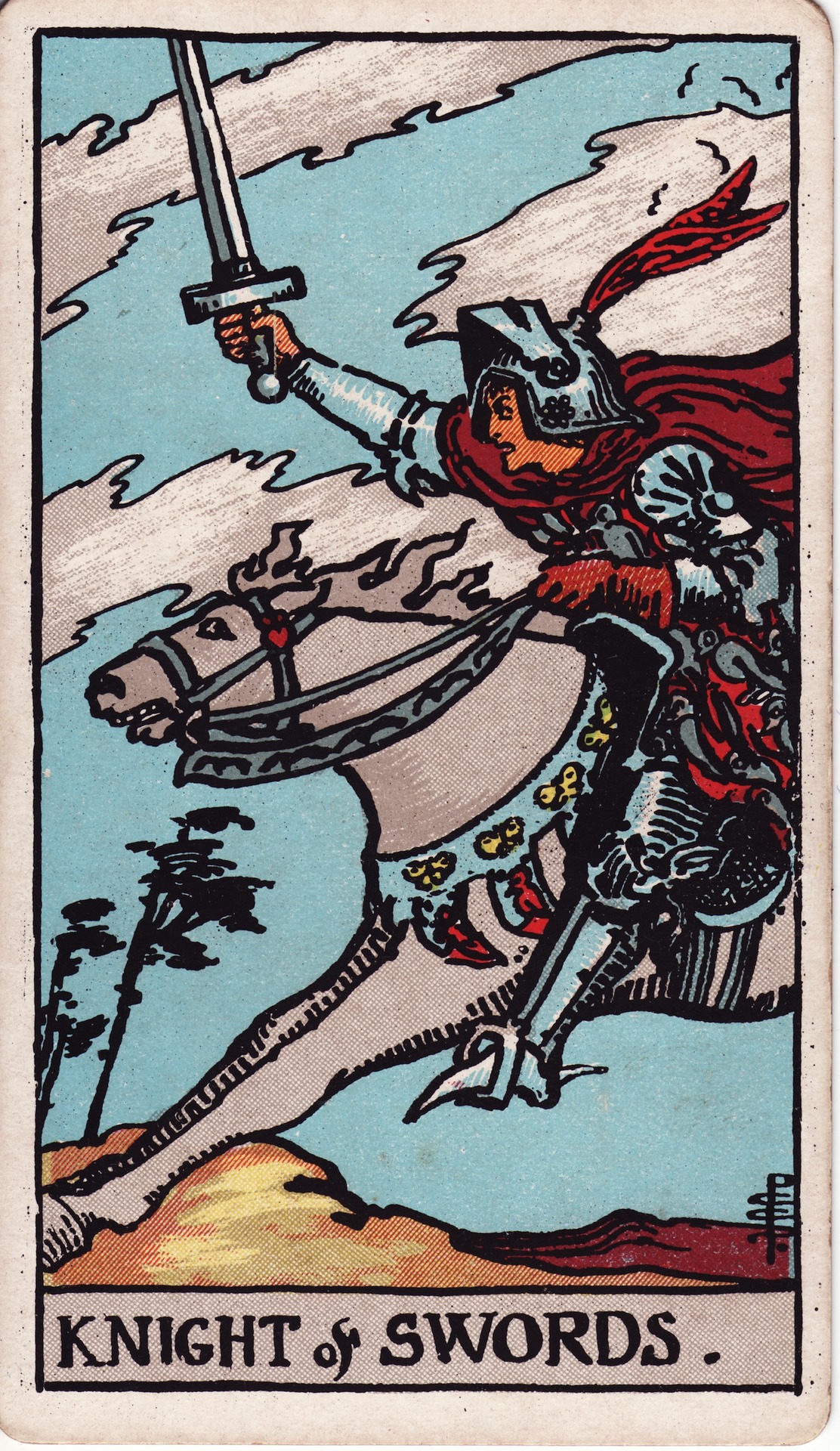
An armored knight charges at full gallop across the card from right to left, his sword raised high above his head. His red cape and the red plume on his helmet stream out behind him. His pale horse runs flat out with its mane flying, its harness decorated with butterflies and small red birds. The clouds are torn into streaks, a few birds are scattered high in the sky, and two thin trees at the left bend in a hard wind. There is nothing gentle in the image; every line is moving forward fast.
Waite called him "a proto-typical hero of romantic chivalry," comparing him to Galahad, whose sword is swift and sure because he is clean of heart.1 Knights carry the energy of their suit into action; in swords, that means thought turned into a charge. The weather is turning against him and he rides straight into it rather than waiting for it to pass. The raised blade reads as commitment to the task, and the pale horse as thinking still unclouded by doubt or compromise.2
Upright
The Knight of Swords is ambition and action at full speed. Once a goal is in sight, he rides straight for it, driven by conviction and impatient with anything that slows him down. Waite's meanings combine courage and conflict: skill, bravery, capacity, defense, address, but also enmity, wrath, war, destruction, opposition, and resistance.1 Obstacles do not turn him aside, because he already knows where he is headed. In a reading this is often a push to make the first move yourself instead of waiting for events to arrive, and to treat the future as something you build.2
As a person, the Knight of Swords is assertive, articulate, quick-thinking, and direct to the point of bluntness. Waite's additional notes describe him as a soldier or man of arms.1 He wants to understand things by reasoning them through, holds firm views and can defend them well, and is happiest trading ideas with people as sharp as he is, each pushing the others further.2 He can be a brilliant advocate or a fearless defender, and also someone who charges in without looking, steamrolls opposition, and leaves damage behind.
The cost of his speed is that he rarely plans. He may not see the problems ahead, may cut corners to get finished, or may set off side effects he never considered. Sometimes the goal he chases so hard turns out, once reached, to be the wrong one or a dead end.2 A little preparation before the charge saves a great deal of repair after it.
In love, it can signal a fast-moving romance with someone forceful and exciting, or a partner who argues hard and rarely backs down. At work, it favors bold moves, arguing your case, pursuing a goal decisively, and taking on a challenge others avoid. With money, it may mean a sudden decision, which can pay off or backfire. On the inner level, the card asks whether your speed is serving you. Drive and clarity are gifts; so is checking the ground before you ride over it.
Reversed
Reversed, the knight's force runs ahead of his judgment. Waite's reversed meanings are imprudence, incapacity, and extravagance: energy wasted on the wrong targets, plans launched without preparation, or ambition that outruns ability.1 The charge may stall, or it may go wildly off course. In the mind this shows up as scattered thinking: ideas picked up and dropped, decisions reversed from one day to the next, choices made on impulse. Anyone following such a leader is left confused, and even working alone, the constant mental chatter keeps anything from getting finished. The cure is discipline: choose one idea and stay with it to the end.2
As a person, the reversed knight can be reckless, aggressive, or domineering, someone who interrupts, bulldozes, and refuses to consider anyone else's point of view. Waite's additional notes give a dispute with a foolish person, and for a woman, a struggle with a rival who will be conquered.1 In love, it may show arguments that escalate quickly or a partner who is all intensity and no staying power. At work, it warns against rushing a project or burning bridges with colleagues. With money, avoid risks taken on a whim.
It can also mean the opposite: plenty of drive and nowhere to spend it. The timing may be wrong, resources may be short, or you may be waiting on someone who is not ready, and the frustration builds until it needs some other outlet before it breaks out somewhere unhelpful.2 Trying to take part in everything at once leads the same way, toward exhaustion with little to show for it; step back, get your footing, and keep only the few priorities that matter.2
Some readers also see a knight who needs to ride alone for a while, gaining experience and maturity through independence. He will make mistakes on the way, and they are part of growing up rather than proof of failure.2 Either way, the remedy is to slow down, pick your battles, and let your thinking catch up with your speed.
Notes
- A. E. Waite, The Pictorial Key to the Tarot (1911), Knight of Swords, https://sacred-texts.com/tarot/pkt/index.htm
- Biddy Tarot, "Knight of Swords Tarot Card Meanings", https://www.biddytarot.com/tarot-card-meanings/minor-arcana/suit-of-swords/knight-of-swords/