Page of Swords
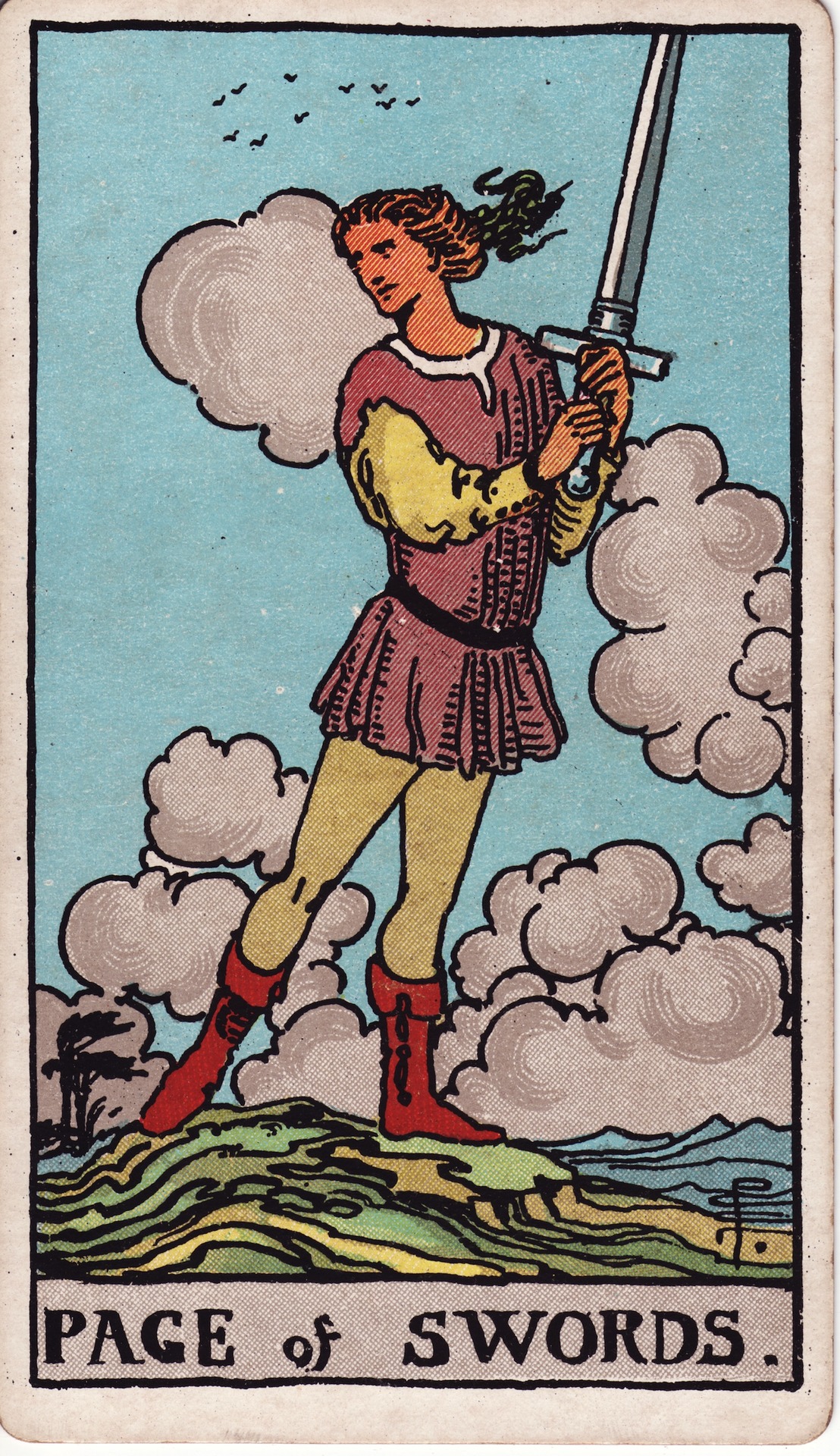
Appearance
A young figure stands on a rough, grassy hilltop holding a sword upright in both hands, as though ready to strike or defend. His hair is tossed by a strong wind, and he looks back over his shoulder, alert. He wears a belted rose-colored tunic over yellow sleeves, with red boots. Behind him, clouds pile up in a bright blue sky, a flock of birds flies high on the left, and wind-bent trees stand at the far edge of the ground. In the distance lies a low landscape of water and hills.
Waite described the page as lithe and active, looking this way and that, as if an expected enemy might appear at any moment.1 Notice the split in his posture: body and blade are set one way while his eyes go the other, a mind committed to a course but still scanning its surroundings.2 The hurrying clouds give the scene its restlessness, yet the ground under his feet is green, a hint that his ideas, raw as they are, can take root and lead somewhere good.2 Pages are the students and messengers of their suits; this one brings air in its youngest form: curiosity, vigilance, and words.
Upright
The Page of Swords is curiosity with an edge. It is the card of new ideas, questions, and the restless energy of a mind that wants to know everything. Waite's meanings are authority, overseeing, secret service, vigilance, spying, and examination, so there is also a watchful and sometimes suspicious quality to it.1 News, messages, and fresh information often arrive with this card.
The page is a beginner, and the card often marks the start of a new line of thought: a new subject, a technique, a different angle on an old problem. Expect to collect facts greedily and to get some of them wrong. This is the stage of exploring, not of mastery, and the page's saving grace is that a mistake only makes him more interested.2 There is plenty of fuel at first; the real question is stamina, since Pages start well and the follow-through has to come from somewhere else.2
As a person, the Page of Swords is someone young or young at heart who is quick, talkative, sharp-witted, and eager to debate. They notice everything and may not know when to stop asking. They can be a gifted student, a budding writer, or an investigator in the making, but also a gossip. Living or working alongside them can be tiring, since Swords carry friction and the stream of questions wears on people. Step away when you need to and come back fresh; for all their inexperience, they may show you something about yourself.2
In love, it can mean a lively mental connection, honest but blunt communication, or someone who keeps their guard up and tests a partner before trusting. At work, it suits learning, research, planning, and roles that call for analysis or communication, and it encourages you to speak up with new ideas. It may also be the push to try a new outlet for them, such as giving talks, starting a blog or podcast, or drafting a book, and to learn by trying which form suits you.2 If you have been waiting for a sign to start a project, this is a yes: there will be obstacles and not everyone will approve, but the page favors moving.2 With money, it advises gathering information before you commit. On the inner level, the page asks you to stay curious and alert, and to make sure your quickness of mind is matched by a willingness to listen.
Reversed
Reversed, the page's sharpness turns careless or sly. Waite gives the more evil side of the upright qualities, what is unforeseen, an unprepared state, and also sickness.1 Vigilance becomes paranoia; examination becomes snooping. His additional notes put it plainly: an indiscreet person will pry into the querent's secrets.1
A less common reading runs the other way, with the voice held in rather than let loose. You may keep your opinions to a diary, to private conversation, or to an anonymous name, or hold a view on some public question that you have not yet shaped into a clear statement. Here the card is a nudge to work out what you mean and say it openly, fear and all.2
As a person, the reversed page may be someone who talks without thinking, spreads rumors, makes promises they cannot keep, or uses clever words to cover a lack of substance, sometimes inflating their own history with tales that shrink on closer inspection.2 They may also be defensive and cutting, quick to argue and slow to admit a mistake. The habit of questioning can turn into a burden on others, with every point challenged and every idea picked over. If that is you, ask in a way that invites explanation rather than putting people on trial, and save the challenges for things that really matter to you.2
In love, watch for words used to wound, or for someone who is all talk and little follow-through. Before you promise, be sure you can deliver, and when others promise you something, build in a way to check that they do.2 At work, it can show hasty decisions, ideas announced before they are ready, or being caught unprepared. Often there is no shortage of energy, only too many fronts at once; take tasks one at a time and the results will mean more.2 With money, it warns against acting on a rumor.
Waite also records astonishing news as a reversed meaning, and it can arrive suddenly and in either direction.1 Inwardly, the reversed page may be scattered thinking or anxiety running ahead of the facts. Slow down, check your sources, and think before you speak.
Notes
- A. E. Waite, The Pictorial Key to the Tarot (1911), Page of Swords, https://sacred-texts.com/tarot/pkt/index.htm
- Biddy Tarot, "Page of Swords Tarot Card Meanings", https://www.biddytarot.com/tarot-card-meanings/minor-arcana/suit-of-swords/page-of-swords/