Seven (7) of Wands
Appearance
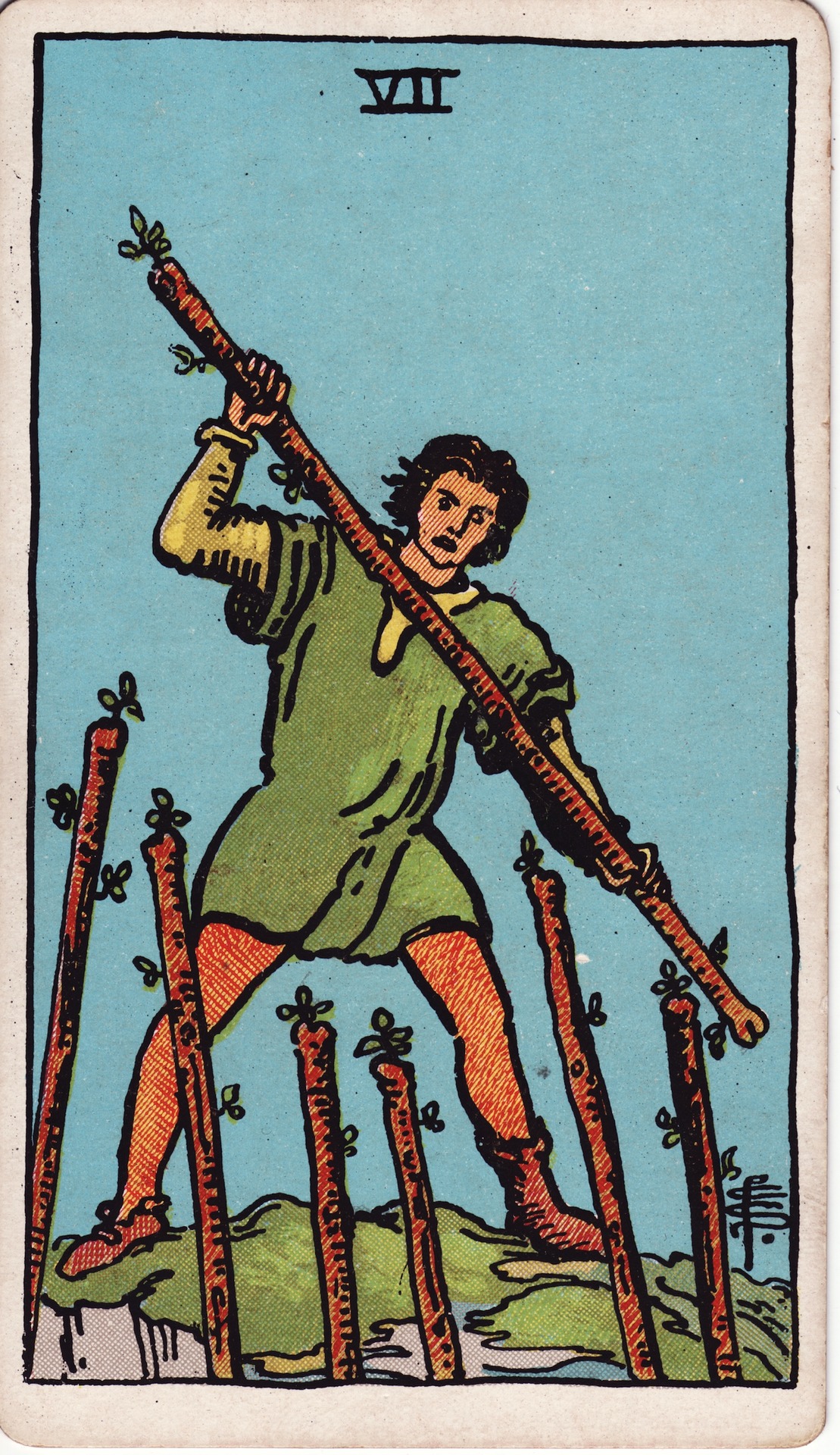
A young man in a green tunic stands on top of a rise, gripping a wand in both hands and holding it across his body to fend off six other wands thrust up toward him from below. Whoever holds them is out of sight. His face is tense and alert, his stance wide. He wears a shoe on one foot and a boot on the other, which is often read as a sign that he was caught off guard and dressed in a hurry. A less common reading turns the mismatch inward: he is fighting hard for the spot while not entirely sure where he himself stands.1 The sky behind him is a flat bright blue.
Sevens often bring a test of position or resolve. Waite read the card as valor: on the surface six are attacking one, but the one holds the vantage point, and his enemies may be unable to reach him.2 Placed right after the victory ride of the Six of Wands, the scene also shows what winning tends to bring with it. The hilltop is worth something now, and other people have noticed.1
Upright
The Seven of Wands is the card of standing your ground. You have reached a position worth holding, and now others want it, challenge it, or push back against it. The card does not promise an easy fight, but it gives you the high ground and the energy to defend it. Often the pressure is a side effect of doing well: the more visible you become, the more people show up to argue with you or to try to pull you down, and some of that hostility is just the cost of being seen.1
At work, it often appears in competitive situations: defending a proposal in a meeting, protecting your role against a rival, holding a business position against competitors, or sticking to a decision under pressure. Waite's meanings include discussion, wordy strife, negotiations, war of trade, and competition, and he also called it a card of success, since the one on top may be out of reach.2 It is a good time to gather allies, a team you can trust and, if the stakes are high, legal advice.1 With money, it favors protecting what you have built. The card also turns up when you are about to say something unpopular in public, in a post, a talk, or a meeting; know your reasons well enough that pushback does not knock you off them.1
Like the man in the mismatched footwear, you may find yourself fighting before you feel ready. The lesson for next time is to look ahead: before starting something, list what could go wrong and keep a fallback in mind for the worst of it.1 For a creative project, the card can mean an outside obstacle in the way of the work, and the answer is firm boundaries and plain stubbornness.1
In love, it can point to a relationship that needs defending against outside pressure, such as family disapproval or interference, or to someone holding firm to their own boundaries within a relationship. It can also mean standing up for what you want rather than giving way just to keep the peace.
On a personal level, the card is about conviction and courage. It asks whether the position is worth defending, and if it is, to hold it without apology.
Reversed
Reversed, the defense wears thin. You may feel outnumbered, exhausted by constant challenges, or ready to give up a position you once fought for. At work, this can mean being overwhelmed by competition or criticism, losing confidence in a plan under pressure, or yielding ground you did not need to give. Sometimes the trouble is simply too many fronts at once, and the fix is to drop most of them and defend the one or two that matter.1 Comparing yourself to rivals can leave you feeling small; the work then is rebuilding confidence before rebuilding the wall.1
The reversal can also be a habit of giving in. If you fold the moment anyone objects, ask whether being liked has become worth more to you than what you believe.1 You will not win everyone over, and at some point the honest move is to say plainly what you are and what you need, without opening it to negotiation.1
The other side is defensiveness: treating every question as an attack, fighting battles that do not exist, or refusing to compromise when a little flexibility would end the conflict. In relationships, this can look like constant guardedness, or arguments where both sides care more about winning than understanding. It can also be the sense that friends or family are always second-guessing your choices, such as the partner you stay with or the job you keep, and you wish they would leave it alone.1
Waite's reversed meanings are perplexity, embarrassment, and anxiety, with a specific caution against indecision.2 Wavering is the real danger here. Decide what you are defending and why, and then either stand firm or let it go cleanly. If you have given it everything and it still is not worth the fight, walking away is not defeat.1
Notes
- Biddy Tarot, "Seven of Wands Tarot Card Meanings", https://www.biddytarot.com/tarot-card-meanings/minor-arcana/suit-of-wands/seven-of-wands/
- A. E. Waite, The Pictorial Key to the Tarot (1911), Seven of Wands, https://sacred-texts.com/tarot/pkt/index.htm