Six (6) of Wands
Appearance
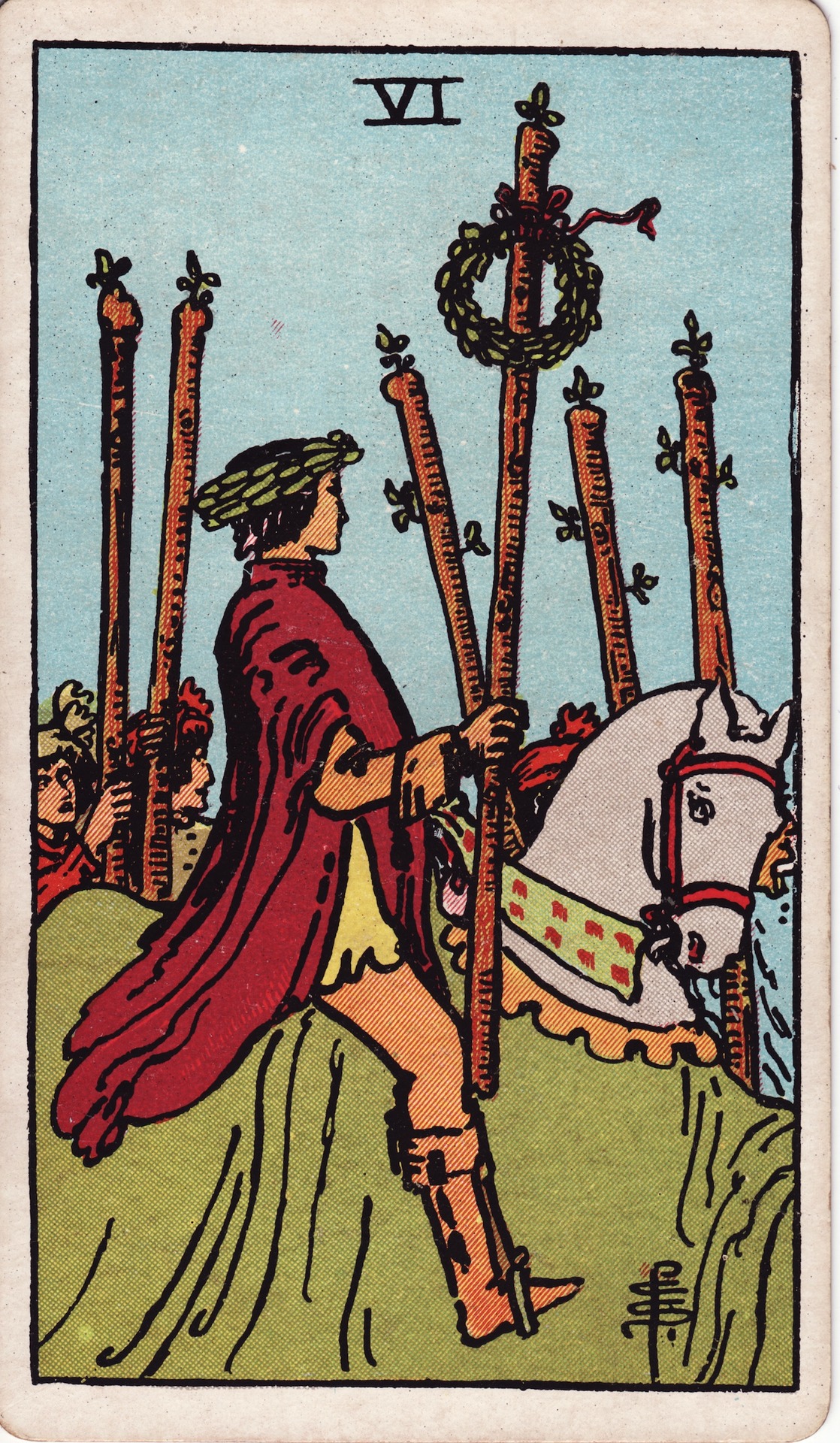
A young man wearing a laurel wreath rides a white horse through a crowd. He holds a tall wand with a second laurel wreath tied near its top by a red ribbon. He wears a long red cloak, and his horse is draped in a green cloth that falls almost to the ground. On foot around him, people carry five more wands upright, and at the left a few faces turn up toward him. The sky is pale blue, and the scene has the feel of a public procession.
The white horse can be read as strength kept clean, the power that carried a venture forward without being soiled by the fight, and the rider makes no attempt to hide his win; the people around him seem glad to cheer it.1 Sixes often bring harmony or resolution after the struggle of the five. Waite described the card as a victor triumphing, but also as great news carried in state by a courier, and, in his words, expectation crowned with its own desire.2
Upright
The Six of Wands is the card of victory and public recognition. A challenge has been met, and others can see it. Unlike private satisfaction, this success comes with an audience: praise, acclaim, the feeling of being carried through the streets. Waite's meanings include triumph, great news, and the crown of hope.2 The win usually came from narrowing down. Out of the scattered clashing of the Five, you picked one aim and put your effort there, and that focus is what got you through.1
At work, it is one of the clearest signs of success: a promotion, an award, a deal won, a project praised, or a well-received launch. The recognition need not be grand; a colleague's word of thanks counts, and even that small notice can give you the fuel to keep going.1 It favors stepping forward to take credit for what you have done and letting others see your strengths. It can also mean good news arriving, the result you hoped for. With money, it supports gains that come from reputation and visibility.
In love, it can point to a relationship that others celebrate, pride in a partner, or confidence that makes you attractive. For someone single, self-assurance is the draw. After a difficult period in a relationship, it suggests having come through it together.
On a personal level, the card is about self-confidence and the value of acknowledgment. It is fine to enjoy being seen, and if guilt or a fear of seeming boastful makes you shrink from the moment, the card says to let that go and accept the support of the people who are genuinely happy for you.1 The laurels, though, are a public reward, and the card carries a quiet reminder that success also depends on the people walking alongside you. It also marks a stage, not the end of the road. There is more ground to cover and likely more obstacles, but you will meet them with backing you did not have before.1
Reversed
Reversed, the parade falters. Recognition fails to arrive, credit goes to someone else, or a win turns out smaller than expected. At work, this can mean a promotion passed over, a public setback, or a dent in your reputation, sometimes as silence where you expected feedback, sometimes as open criticism. If a venture has soured badly, it may be wiser to start fresh somewhere new and rebuild your standing there than to keep patching what is already broken.1 It can also show the opposite fault: success that has gone to the head, arrogance, or a need for constant praise, the kind of attitude that invites someone to cut you down to size.1
Waite's reversed meanings are vivid: apprehension and fear, as of a victorious enemy at the gate; treachery and disloyalty, as of gates being opened to the enemy; and indefinite delay.2 In relationships or at work, watch for an ally who may not be as loyal as they seem.
A gentler reading is a success kept quiet. You may have reached something that matters to you and simply not want an audience, either because it is personal or because praise makes you squirm. That is fine, but it is worth asking honestly whether the silence comes from privacy or from a lack of confidence.1
Inwardly, the reversed Six often points to self-doubt or to a reliance on outside approval. If your sense of worth rises and falls with the crowd, it will never feel stable. Measuring yourself against others hands them your power; the work here is to decide what success means by your own values, which then makes your choices clearer and your confidence more your own.1 Waite's additional notes also give the reversed card a gentler meaning, the fulfillment of a hope long deferred, so success that has been delayed may still arrive.2
Notes
- Biddy Tarot, "Six of Wands Tarot Card Meanings", https://www.biddytarot.com/tarot-card-meanings/minor-arcana/suit-of-wands/six-of-wands/
- A. E. Waite, The Pictorial Key to the Tarot (1911), Six of Wands, https://sacred-texts.com/tarot/pkt/index.htm