The Emperor (IV)
Appearance
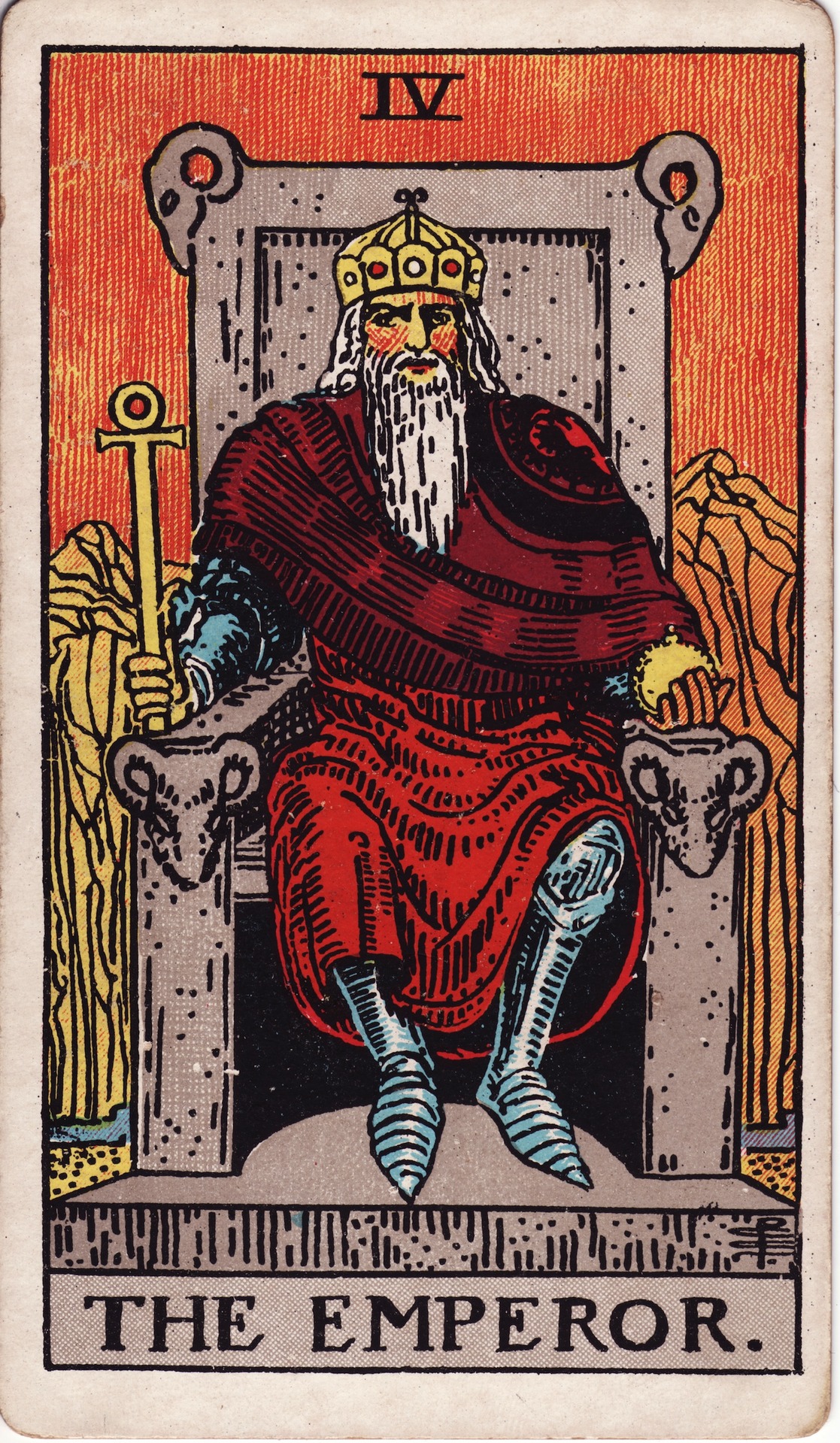
A king with a long white beard sits squarely on a massive gray stone throne, facing the viewer. Four rams' heads are carved on it, two at the top corners and two on the arms. He wears a gold crown and a red robe, and beneath the robe a suit of armor shows at his arm and on his legs. In his right hand he holds a golden scepter in the form of an ankh, the Egyptian sign of life; in his left is a golden orb. Behind him rise steep, bare mountains under an orange sky, with a thin line of water at their foot. Almost nothing grows anywhere in the scene.
Waite called him "executive and realization, the power of this world," the masculine power to which the Empress responds.1 The rams point to Aries and Mars, and the orb is the realm he governs.2 The armor under the red robe shows a ruler ready to defend his gains, and his own feelings too.2 The mountains are an unshakable base that also makes him slow to change. The stream at their foot hints that emotion still runs under the stone, for anyone who earns his trust.2
Upright
The Emperor stands for structure, authority and the steady exercise of power. Waite's meanings are stability, power, protection, realization, aid, reason, conviction, authority and will, and "a great person."1 The Empress is the deck's mother figure and he is its father.2 Where she lets things grow, he sets boundaries, makes rules and holds the line. The card often appears when a situation needs order: a plan, a schedule, a firm decision, someone willing to take responsibility.
It can describe you stepping into that paternal role, whatever your gender: the provider, the protector, the steady person others lean on when things get shaky.2 The card also suggests a method. Faced with a mess, take it apart, work out the steps each piece requires, put them in order, and keep to the plan through to the finish.2
At work, it can point to leadership, promotion, management, or dealings with a boss, a government office or an established institution. It favors discipline, strategy and long-term thinking over improvisation. The Emperor at his best is firm and fair: he hears counsel but makes the final call, does not flinch from conflict when his people need defending, and earns loyalty in return. If you are the one in charge, own that authority rather than apologizing for it.2 He can also be the mentor, someone who has learned a great deal and now passes it on as a teacher, coach or experienced friend.2 With money, it advises budgets, contracts and the kind of security that comes from planning. In love, the Emperor can describe a dependable, protective partner, a relationship built on commitment and clear expectations, or a father figure. It can also mean you need to bring more stability to your own romantic life, or that one person in the relationship is taking charge.
On the personal level, the card asks for self-mastery: knowing your limits, keeping your word, and acting from reason rather than mood. Authority, in the Emperor's best sense, is simply the ability to be counted on.
Reversed
Reversed, the Emperor's authority turns rigid or collapses, and the first question is which: is there too much control in your days at present, or too little, and is it helping or hurting?2 In its excess form it becomes control for its own sake: a domineering boss, a parent or partner who allows no disagreement, rules enforced long after they stopped serving anyone. You may meet this in others or find it in yourself, as stubbornness and an inability to delegate or bend. Heavy-handed control often covers insecurity, sometimes an old wound left by a father or other early authority.2 The mirror image is handing your power over to keep such a person pleased. Neither grabbing nor surrendering is needed; the healthier aim is to stand in your own authority while leaving others room to hold theirs.2
In its weaker form, the structure is missing. Plans lack follow-through, discipline slips, finances drift without a budget, and no one takes responsibility. If results are not coming, check for a plan, a routine that serves it, and the will to do the dull or uncomfortable parts.2 At work this can be poor leadership or a power vacuum. It can also be you dodging a leadership role that others already see you in; if the spotlight feels wrong, there may be quieter ways to have influence, such as writing or training others.2 Sometimes the reversal is a push to rebel instead: to leave a rigid hierarchy for somewhere more flexible, or to go out on your own.2
In love, it can mean a relationship without commitment, or one partner leaning on the other to make every decision. It can also be the opposite trouble, where the security you once wanted in a partner has hardened into possessiveness and control, and your independence is shrinking.2
Waite gives two strands for the reversal.1 One is benevolence, compassion and credit, a softening of the throne. The other is confusion to enemies, obstruction and immaturity, which points to authority claimed before it is earned. The advice is to find the middle: enough order to stand on, and enough flexibility to hear other voices.
Notes
- A. E. Waite, The Pictorial Key to the Tarot (1911), The Emperor, https://sacred-texts.com/tarot/pkt/index.htm
- Biddy Tarot, "The Emperor Tarot Card Meanings", https://biddytarot.com/tarot-card-meanings/major-arcana/emperor/