The Empress (III)
Appearance
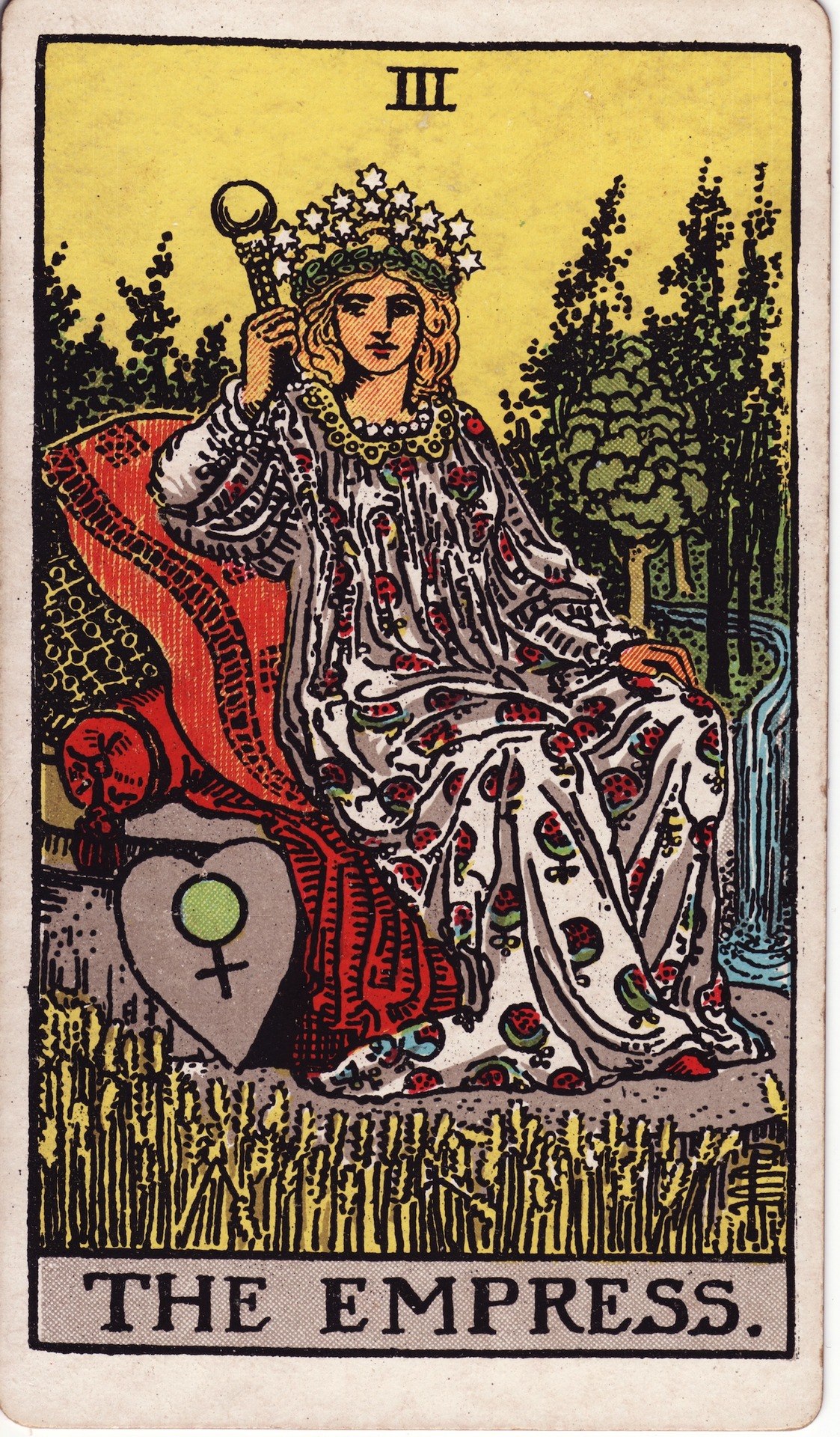
A woman with long fair hair sits on a cushioned seat in the open air, leaning back at ease. She wears a loose white gown printed with pomegranates, a pearl necklace, a wreath of leaves, and a crown of twelve white stars. In her right hand she raises a scepter topped with a globe. Beside her rests a heart-shaped shield bearing the symbol of Venus. A field of ripe wheat grows in front of her, a stand of tall trees rises behind, and a stream falls in a small waterfall down the right side of the card. The sky is a warm yellow.
Waite described her as "the fruitful mother of thousands" and, above all, as universal fecundity.1 She is the earthly counterpart to the High Priestess: one keeps the mysteries, the other presides over the visible, growing world. Her twelve stars can be read as the turning months, the pomegranates as fertility, and the Venus shield as love, beauty and making things. The wheat is a harvest just brought in, and the trees and running water are where she draws her calm.2
Upright
The Empress is the card of abundance, nurture and growth. Things planted earlier are ripening, and the card favors comfort, pleasure in the senses, creativity and care for others. Waite's meanings begin with fruitfulness, action, initiative and length of days.1 Some readers frame her as feminine energy in the broad sense, the receptive, sensual, creative side that everyone needs in balance whatever their gender.2 Traditionally she is also the mother, and the card can point to pregnancy, birth, or a new idea or project that has to be carried, fed and given time before it can stand on its own.2
In love, the Empress brings warmth, affection and sensuality: a relationship that feels generous and secure, a partner who takes care of you or whom you take care of, a home becoming more of a home. For someone single, she suggests attraction that comes from being at ease in yourself. At work, it favors creative projects, steady growth, and roles that involve looking after people or bringing ideas to fruition; effort now yields visible results. With money, it signals prosperity and comfort, enough to enjoy, though the card leans toward spending on beauty and ease. Taking stock of what you already have, and being thankful for it, is part of what lets the good season keep going.2
She can also mean stepping into a caretaking role in a literal way: a new parent, someone looking after other people's children, or a parent making more time for their own. Care given freely here tends to return something to the giver.2
Inwardly, the card is about receiving as much as giving. Time outdoors, attention to the body, good food, music, making things by hand, picking up an art you have never tried, and slowing down to enjoy what you already have all belong to her. A long sit by water or under trees steadies you, and some readers find it opens a quieter, wider kind of awareness as well.2 Growth here is natural and unforced, like the wheat at her feet.
Reversed
Reversed, the Empress's care is either cut off or overdone. On one side lies creative block, neglect of yourself, and the feeling that nothing is growing however much you water it. You may be giving all your energy away to others, or to work, and getting no nourishment back. Burnout, a harsh inner critic about your body or looks, and a sense of dryness are common here.2 A block often comes from worrying how the work will be received; the advice is to make things for yourself alone for a while, privately and without caring whether they are any good, so the flow can start again.2
On the other side is too much of a good thing: smothering, possessiveness, overindulgence, a comfort that slides into inertia. In relationships, this can be a partner who mothers instead of meeting you as an equal, or dependency in either direction, where protectiveness turns into control. The fix is to move from parent and child back to two adults who trust each other to stand alone.2 With money, it can warn of overspending on comfort, or of a project that has been fed but never pruned.
Waite's reversed meanings are unexpected: light, truth, the unraveling of involved matters, public rejoicing, and by another reading, vacillation.1 Something tangled may come clear. Either way, the card asks you to restore balance by tending to yourself first, so that what you give comes from abundance and not depletion, and without the resentment that builds when you have handed your own needs over to someone else.2 Even an afternoon in a park or garden, noticing small living details, can help refill what has run low.2
Notes
- A. E. Waite, The Pictorial Key to the Tarot (1911), The Empress, https://sacred-texts.com/tarot/pkt/index.htm
- Biddy Tarot, "The Empress Tarot Card Meanings", https://www.biddytarot.com/tarot-card-meanings/major-arcana/empress/